High Noon At Taylor Corral

So thanks to Mokhtar, I ended up in this strange cowboy town known as Slim Village. The shops are erected in a horse-shoe pattern and the street sign says Taylor Road. It is really remote and I love it.

Expecting a tumbleweed to roll out anytime or someone to challenge me to a fight, I walked cautiously in the middle of the main street. Wait. There is only one street.

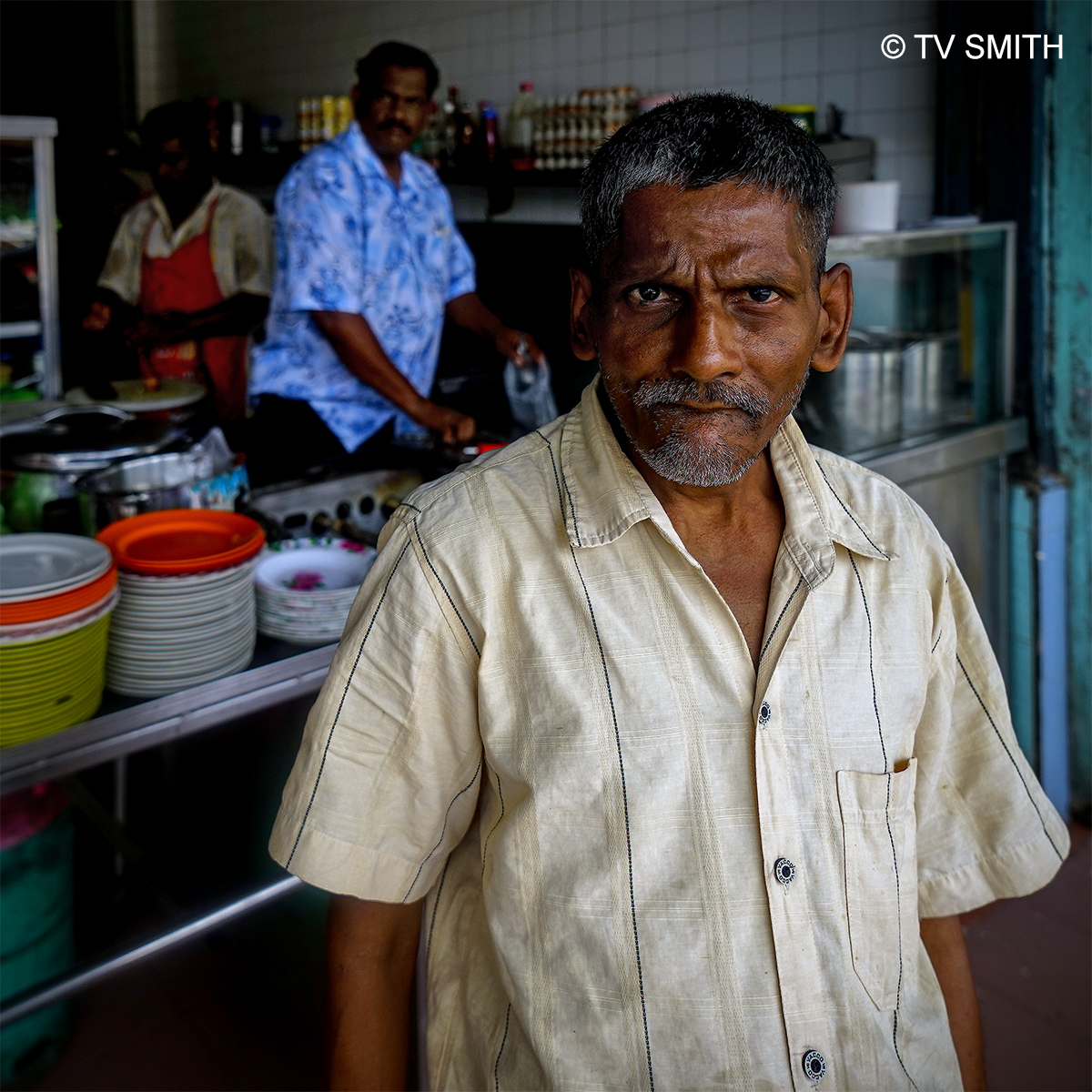
I ended up in front an Indian restaurant. The head waiter came out and stared at me instead of asking if I want to eat or drink. A group of Orang Asli guys inside the coffee shop were also staring at me.

Two nasty Chinese gangster-types eating outside dropped their cutlery and started staring at me, too. The tension was thick enough to fry on the roti prata pan and the silence deafening.

So I stared back as aggressively and took a picture in between. That was the moment the angry-looking cook behind reached for his knife. Since I am facing imminent death, I might as well ask for one last drink.

I asked: “Aneh, Fanta Grape atau Kickapoo ada?” (Do you have Fanta Grape or Kickapoo soft drink?) .

Luckily for me, it turned out be an icebreaker. The unblinking man replied: “Ada Fanta, boss. Mau ais?” (Got Fanta, boss. Ice to go?) .

Suddenly the Chinese gangsters laughed, the cook laughed, and the Orang Asli people laughed and all was cool. Phew!

Sony Alpha a7R, ISO 125, f4, 1/250 sec.
Meeting Jabba The Hutt At Mokhtar’s

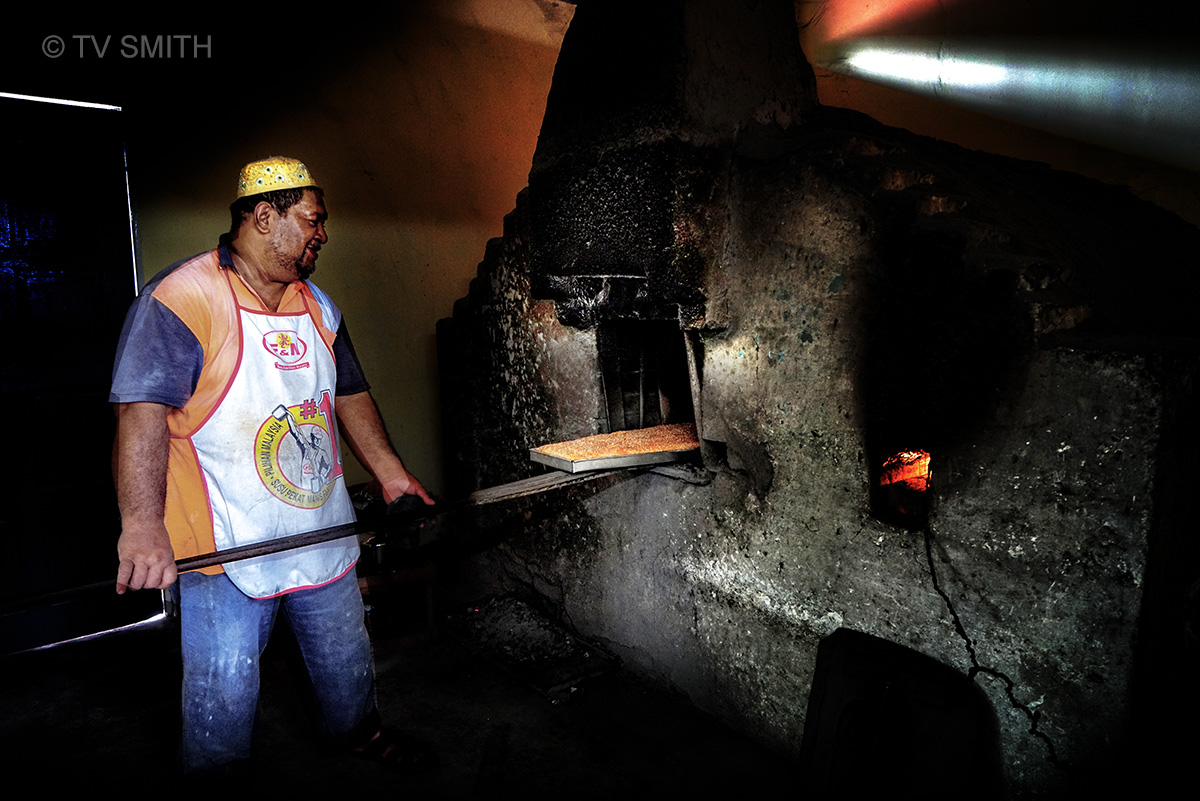
In a darkened room, I met the monster Mokhtar keeps as a pet. I nicknamed it Jabba the Hutt. Built by Mokhtar’s father in 1954, the brick oven is similar in design to those used in villages in India. The masonry oven known as a brick oven or stone oven dates back to medieval times.

Jabba has an insatiable appetite for firewood. Mokhtar’s father used to feed it rubberwood when rubber trees were plentiful in Malaysia. It is now fed with discarded wooden furniture. I asked Mokhtar and his response was: “Kayu getah sangat mahal sekarang, bro” (Rubberwood is very expensive now, bro).

So whenever someone in Slim River wants to discard old furniture, they send it to Mokhtar. The bakery is like a recycling center for wood. He turns wood into ashes and bread.

Mokhtar is a media-savvy person. He knew I wanted to capture the ray of lights spilling out from a hole in the ceiling. He waited patiently as I fine-tuned the power of the Sony HVL-F60M wireless flash.

He (Mokhtar, not Jabba) is a celebrity. I understand he appeared on all local television channels from TV1, 2, 3, 4, 5, 6, 7, 8, 9 to TV 36 or something. He took me to his house nearby to show me newspaper cuttings and pictures framed and hanging from his living room wall.

While there, I noticed furniture was unusually sparse. In my mind, I wanted to ask Mokhtar:

“Bro, if i were to give you a nice IKEA wood table for your birthday, will you promise to assemble it and use it as a table?”

I didn’t ask in the end for I can’t bear to hear his answer. To be continued…

Sony Alpha a7R, ISO 2500, f4, 1/60 sec.

Mokhtar Le Baker

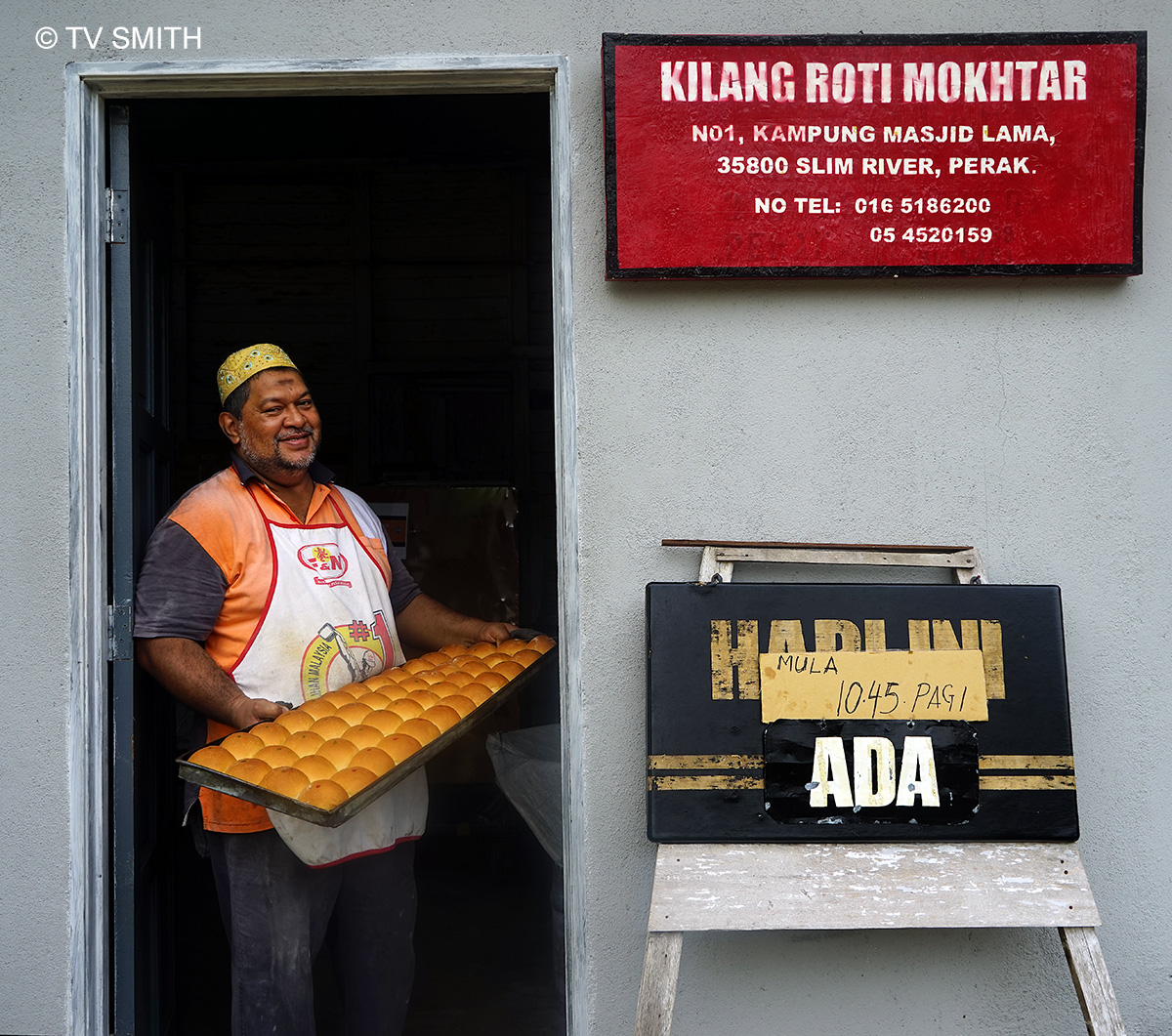
It is unfortunate that this more than half-a-century old bakery is known as a factory (or kilang). In reality, it is a one-man baker outfit and an artisan one at that. Every loaf, bun and pastry is lovingly hand-crafted by Mokhtar himself. No workers, interns or apprentices behind the scenes.

Put him in Klang Valley and call it a boulangerie patisserie instead of kilang and fad-hungry hipsters will swoon all over him , even without him proclaiming sourdough.

We must be thankful that Mokhtar don’t give two hoots about such things. Not even about glutens. The easy-going character don’t care about a lot of things. He opens at 10:30am or thereabouts and closes at 11:30am or thereabouts, earlier when the breads are sold out.

Fortunately for his customers, the man is OCD about signage. On those days when he decides not to open, Mokhtar places signs on the roads outside announcing “Kilang Roti Tutup” (Bread Factory Closed). They are like those middle-of-the-road placards you see when roads are closed for National Day parade rehearsals. After all, the man and the bakery is Slim River’s most famous landmark or attraction.

It took me three trips on three different days before I could catch him in person. Greeted by a shut door previously, I ended up staring at the piles of broken furniture lying around the yard. That kind of gave me a clue on the eccentric character that he is. Don’t tell me he uses all these broken furniture as firewood to fire up the oven, I wondered.

As it turns out, we get along quite well. For I am as eccentric and OCD like him. I keep telling him the door is not perfectly level.

More on the bakery coming up.

Sony Alpha a7R, ISO 100, f8, 1/100 sec.

The Sad Truth

Many of the shops in small towns along Federal Route 1 are dying, if not dead. Mr Yang, a long-time shopkeeper in Slim River town told me he is glad I am here to photograph the town now and not later. I asked why. He said if I were to come later, many more local old businesses will be shuttered or turned into something else.

It is not the new highways that are by-passing old towns or the shrinking population to be blamed, according to this old timer. The bitter truth is there are few young people interested in taking over a traditional family business. To blame other factors is to be in denial; said the man in honest introspection.

Be it a Chinese medical hall, an Indian grocer or a Malay tailor shop, the founder’s younger descendants see their future elsewhere. Mr Yang contends the new generation prefers a business with quick profits.

Nobody wants to idle away their lives stuck with a slow-moving business in a sleepy town. Old money has lost its charm; I added and he concurred.

To steer our conversation to a less-depressing subject, I asked him about remaining unique or interesting businesses in town.

Mr Yang smiled and asked me in Hokkien: “Lu wu chiak bangkali loti boh?” (Do you eat Bengali bread?)

He then pointed in the direction of a Indian-Muslim bread factory that is now in its third (and probably final) generation. I’ll visit it next.

Sony Alpha a7R, ISO 100, f4, 1/320 sec.

Tough Fruit On A Tough Vehicle

Something piqued my interest when I was walking down the street in Slim River town. I saw a Land Rover with a Tooley Electro Mechanical batch on its tailgate.

The now defunct English company from Church Street, Earl Shilton, Leicester used to do conversions for Land Rover vehicles.

Vehicle owner and durian seller Halim at first thought I was examining the durians he was selling from the back of his vehicle.

He was naturally happy when he found out I was a former Defender 110 owner. I wrote and directed a couple of television commercials for the Defender and Discovery some years ago. As such, I know a bit more about the series than the average guy.

I also attend and photograph the Rainforest Challenge International Offroad Competition almost every year. Even though it was a chance encounter, me and Halim ended up talking shop for a long while and became friends.

Halim promised to take me to some secret off-road tracks in the jungles off Slim River and Sungkai in his other 4WD.

Further north in Kampar and Ipoh, there are several workshops and dealers specialising in refurbished Land Rovers.

Of course, there is also the world’s largest fleet (estimated at over 7000 at one time) of mostly ramshackle and heavily-modified Land Rovers at the vegetable farms up in Cameron Highlands.

Jaguar Land Rover decided to stop producing the iconic Defender model come December 2015. It marks the end of an illustrious era for the famous utility and military vehicle launched in 1948.

The successor to be launched in 2018, was shown earlier as the Land Rover DC100 (Defender Concept 100) and I must say the planned replacement looks really awesome.

Sony Alpha a7R, ISO 100, f7.1, 1/320 sec.