Rendang

Historically, the Minangkabau people of Sumatra were of a migrating (merantau) culture. Many left home to start new lives in other Indonesian cities, as well as at regional countries. Soon, Padang restaurants were everywhere.

But there was one problem when they wanted to take food along their long journeys through rivers and oceans. Refrigerators weren’t available in the 16th century.

So the enterprising Minangkabaus came up with Rendang, a form of drier curry meat. The special recipe used a combination of spices and cooking methods that resulted in a dish that will last when stored for weeks at room temperatures.

There are now, of course, many regional and different adaptations in both dry and wet versions. The rendang curry, be it chicken, beef or mutton, goes very well with lemang.

Sony Alpha a7R, ISO 2500, f13, 1/160 sec.
Searching for Captain Slim

I have been in Slim River town and surrounding areas, on and off, for the past three weeks. I wrongly presumed the town is named after a river that is slim and narrow. It wasn’t, it seems.

The river and town were named after the eponymous Captain Slim from the 19th century. The British explorer allegedly discovered the river by accident when he got lost.

There is not much info online, except the same info repeated everywhere as fact, when there are no citations or references.

How can someone who had a town and river named after him had no records? Maybe I was looking at the wrong places but is still odd.

Many British sailors would have kept detailed logs and diaries, even if the captain didn’t. Could this be a romantic anecdote morphed into an urban legend?

It is also quite strange as Slim River, the river, is shallow and rocky. Today, it is a white water rafting location, upstream. He’ll be lost today too, as the river is not on Google Map.

I decided to drive alongside the river and talk to village elders to see if they can recall anything they might have heard pass down from their ancestors.

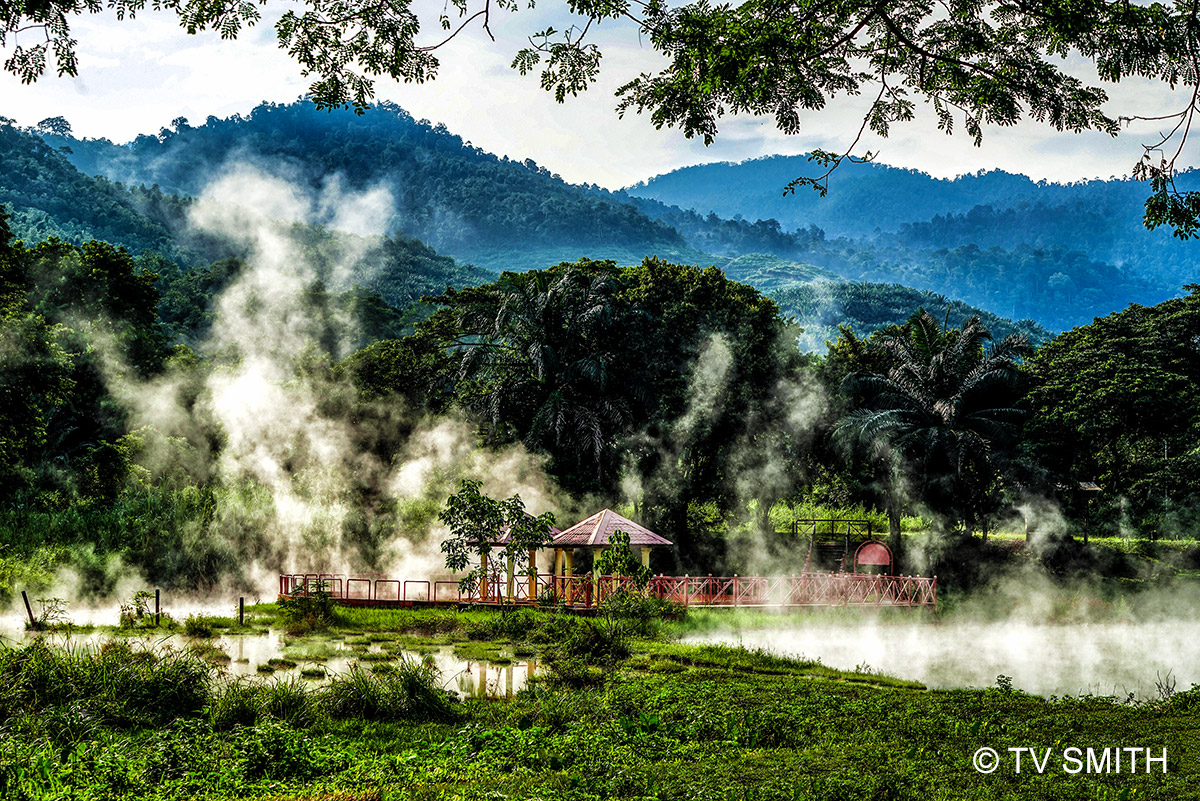
If the good captain existed, and if he got off his boat at this juncture, he would have seen this amazing sight (minus the rails and gazebo).

This is the Ulu Slim hot springs I visited the other day. It is magical today as steam shot up high because of the downpour.

Surrounded by rolling hills and rainforests, this is one of the most beautiful natural sights in Malaysia. Slim River, the river, is about 50 meters behind me.

Sony Alpha a7R, ISO 100, f11, 1/160 sec.

The Sad Truth

Many of the shops in small towns along Federal Route 1 are dying, if not dead. Mr Yang, a long-time shopkeeper in Slim River town told me he is glad I am here to photograph the town now and not later. I asked why. He said if I were to come later, many more local old businesses will be shuttered or turned into something else.

It is not the new highways that are by-passing old towns or the shrinking population to be blamed, according to this old timer. The bitter truth is there are few young people interested in taking over a traditional family business. To blame other factors is to be in denial; said the man in honest introspection.

Be it a Chinese medical hall, an Indian grocer or a Malay tailor shop, the founder’s younger descendants see their future elsewhere. Mr Yang contends the new generation prefers a business with quick profits.

Nobody wants to idle away their lives stuck with a slow-moving business in a sleepy town. Old money has lost its charm; I added and he concurred.

To steer our conversation to a less-depressing subject, I asked him about remaining unique or interesting businesses in town.

Mr Yang smiled and asked me in Hokkien: “Lu wu chiak bangkali loti boh?” (Do you eat Bengali bread?)

He then pointed in the direction of a Indian-Muslim bread factory that is now in its third (and probably final) generation. I’ll visit it next.

Sony Alpha a7R, ISO 100, f4, 1/320 sec.

Forgotten History: Battle of Slim River

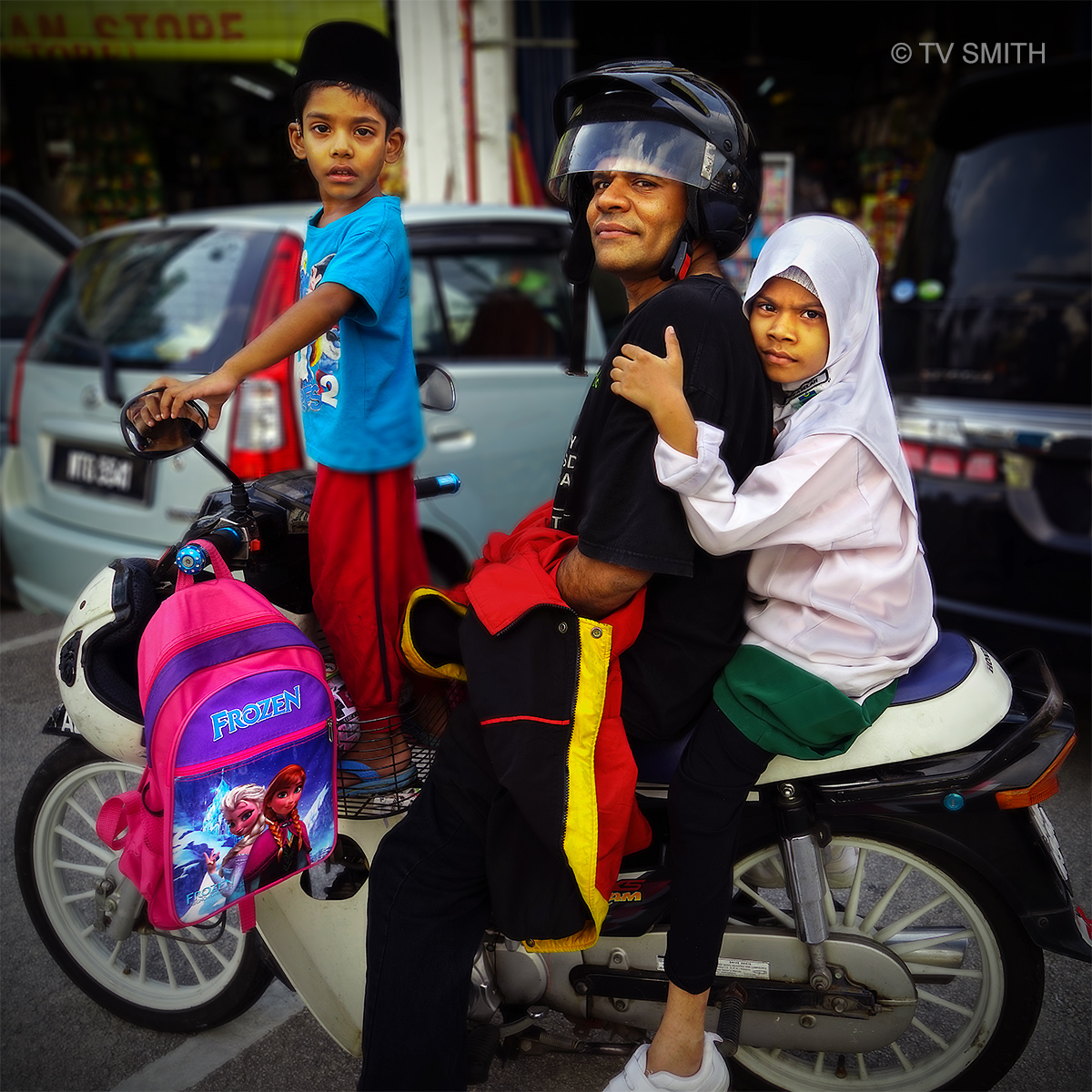
Continuing my stroll down main street, I met this family on a bike. The mother is dropping the kids in front of P.K.Mohamed Mastan & Sons.

I learned that the Indian-Muslim grocery shop was founded before World War 2. They stressed their grandfather settled here before the Japanese Occupation; perhaps as a reminder of the turbulent history the town went through.

The Battle of Slim River was fought here in 1942. Some 500 soldiers from the British Indian Army lost their lives fighting the invading Japanese Imperial Army. 3,200 men were captured.

The assault force using tanks was commanded by Major Toyosaku Shimada. The British commander was Acting Major-General Archibald Paris.

Indian soldiers were from the Hyderabad, Gurkha and the Punjab Regiment. The experienced Punjabis set fire to a few tanks with molotov cocktails.

Destroyed tanks caused a bumper-to-bumper tank crawl on Federal Route 1. That left the enemy exposed and vulnerable but unfortunately artillery units did not arrive on time.

Staring at the road, I made a silent salute to the brave and unsung men who defended Malaya. Read more on the fierce Battle of Slim River on Wikipedia (https://en.wikipedia.org/wiki/Battle_of_Slim_River).

Sony Alpha a7R, ISO 100, f4, 1/250 sec.

Bak Chang

Today is Duanwu ( 端午节) or the Dragon Boat Festival or the Chang Festival for Chinese. It falls on the fifth day of the fifth month of the lunar calendar and as such is also known as the Fifth Month Festival in Malaysia, Singapore and Taiwan.

The festival commemorates the life and death of ancient Chinese scholar and poet Qu Yuan. He committed suicide by drowning to protest against the corrupt and dictatorial regime that ruled.

Legend has it that people threw rice into the river both as a food offering to Qu Yuan’s spirit and also to deter fish from eating his body.

Today, symbolic glutinous rice or sticky rice dumplings known as zongzi (粽子) are eaten to mark the occasion. It is a public holiday in China, Hong Kong, Macau and Taiwan. Locally, the bamboo leaf-wrapped dumplings are known as bak chang (Hokkien) or choong (Cantonese).

Interestingly; the Chinese in Indonesia refer to the festival as ‘Peh Cun’ and it is known as ‘Festividade do Barco-Dragão’ in the former Portuguese colony of Macau. The dumplings are known as ‘Machang’ among Chinese Filipinos.

I like this simple dumpling from a roadside seller in Kampung Cempaka. It has salted duck egg yolk, fatty meat, dried shrimps (heh bee), mushroom and importantly for me; no mung beans.

The humble kiosk provides a no-bean option. Freedom of choice: Something which Qu Yuan stood for.

Sony Alpha a7R, ISO 2500, f6.3, 1/250 sec.