The Sungai Selangor Dam

About 5 km from Kuala Kubu Bharu town (or about 6.5 km from Federal Route 1) is the massive Sungai Selangor Dam. In this lesser seen view from a hill, one can see the brownish dam crest and embankment.

The 110 metre-high rockfill dam was designed to store and regulate a maximum capacity of 235 million cubic metres of water. The crest length or span is 800 metres. One of two water treatment plants is located in Rasa, a town I visited previously.

The dam supplies 60% of Klang Valley’s potable and piped water. Rain over the catchment area should be a good sign. Any severe water level drop (due to a prolonged dry spell) may trigger yet another crisis.

Olympus OM-D, ISO 200, f9, 1/320 sec.

Ampang Pecah

From Kerling, I turned east on Federal Route 1 to head for Kuala Kubu Bharu town. Although KKB is rich in history and its route to the east is geographically significant, the town is known more for its colonial charm and surrounding greenery.

Hipsters flocked there for different reasons, though. The Hainanese bread shop that used to beguile them is now closed. Not to worry: they now lie on the middle of the road for a selfie. They pretend the modern interlocking tiles are ancient cobblestones.

KKB is also a stopover town for those traveling to Fraser’s Hill. Oddly, few visitors wonder about the logical existence or location of an older town.

Indeed, there was a Kuala Kubu without the fancy suffix or hip abbreviation. Tragedy struck the original town in 1883 when a nearby dam broke. It flooded and destroyed the entire town, killing a few dozen residents.

The then British colonial government built a replacement town a few kilometers away and it was named Kuala Kubu Bharu. Duh.

The annihilated town was subsequently renamed Ampang Pecah to mean Broken Dam in Malay.

This landscape was photographed in the Ampang Pecah area. With over a century to heal, it has recovered from site of mass destruction to become a serene and idyllic suburb of KKB. Few outsiders ever step foot here or know about its stormy past.

Sony Alpha a7R, ISO 100, f11, 1/800 sec.

Kerling Hot Springs

Met a Chinese family swimming in the river and they asked me where I am from. I told them KL and they asked: “How on earth did you manage to find this place?”. They said even though they are locals, they got lost getting here the second time around.

Since it is a weekday, the place is almost deserted. I was told on crowded weekends, it is also visited by locals mostly. Nice that the locals have their own secret and very remote hideout for recreation and picnics. Maybe not (so secret) anymore.

I went to look for the hot springs on another side. It is channeled into a pool and inside was sweet Sheela with the coy smile, and splashing hot water Kollywood-style. She’s also a local and works in an office in Batang Kali.

Sony Alpha a7R, ISO 100, f11, 1/400 sec.

The Rusty Bridge

I was told there is a nice waterfall and hot springs in the jungles of Kerling. There is a sign by the main road but it turned out to be quite a long road in. The drive started parallel to a railway track, twisted through rustic villages and ended up alongside rolling hills.

With such picturesque scenery, is easy to miss a follow-through sign, if there was one in the first place. At certain crossroad, road split or T-junction you are on your own.

You can either make a wild guess or an educated guess. At one sign-less junction, I stopped by the roadside and waited a bit. Sure enough, two helmet-less village girls on a motorcycle came flying out. They were speed-drying their wet hair in the wind. By following the road they rocketed out from, it should take me to a swimming area.

The deeper I went, the narrower and lonelier the road became. I think most people driving alone would have turned back. Somewhere along the way, I saw a rusty bridge over a river. Was quite wobbly to walk on but its appearance against the sunny landscape today made the stopover worthwhile.

Panasonic GM-1, ISO 200, f10, 1/400 sec.

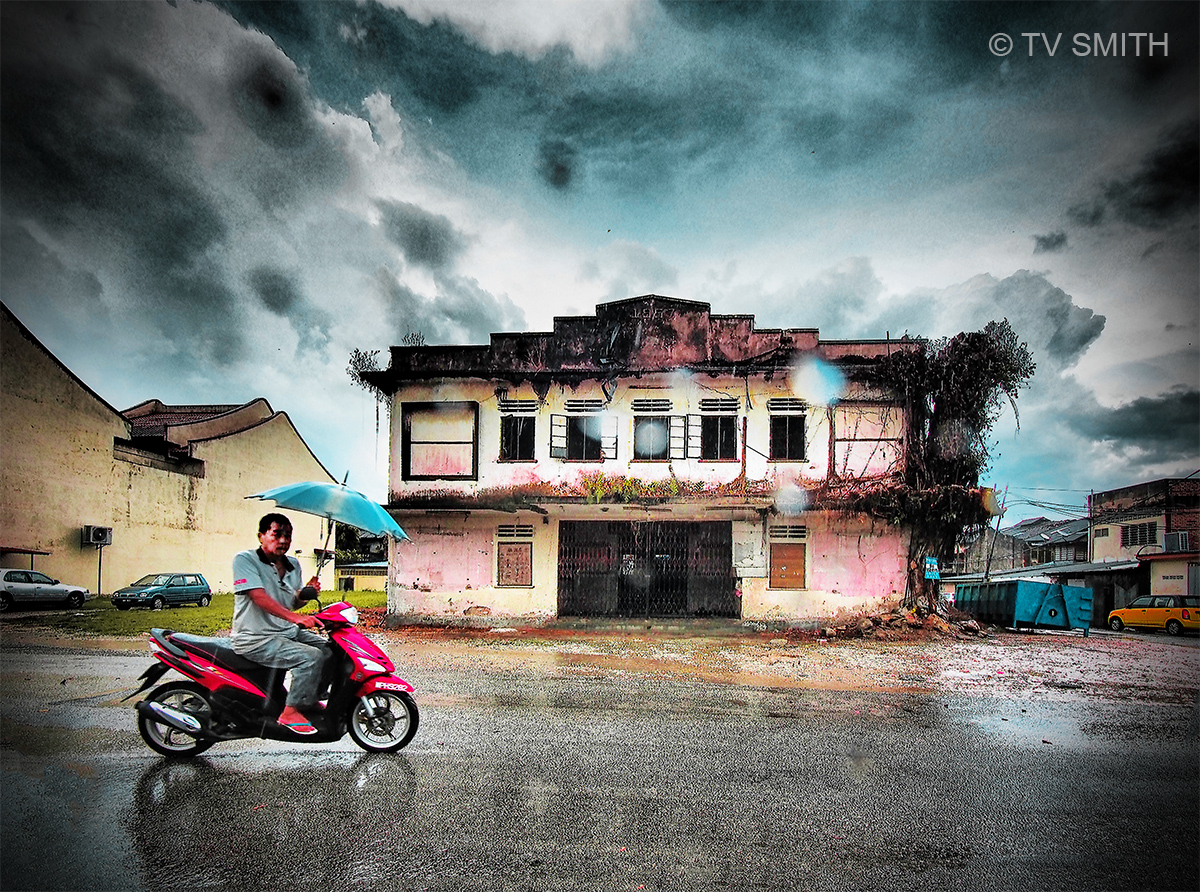
Rain Or Shine, The Show Must Go On

One of the things I decided from the get-go was to proceed come rain or shine. It would be impossible to find a continuous stretch of sunny days with the vagaries of our weather.

If it shines, the camera will absorb the colours. If it rains, I get to capture the wet landscape and activities. After all, this is documentary photography and I will go with the flow.

For this cinema in Rasa town, the show didn’t go on. Sad to see a building from 1957 left dilapidated and forsaken. Even sadder to see what looks like an equally old tree by its side; beheaded.

Rasa is the first town on the route that hit me as a dying town. Many of the buildings there are from 80 to 100 years ago but are are left abandoned. I have to find out why.

Olympus OM-D, ISO 200, f7.1, 1/200 sec.