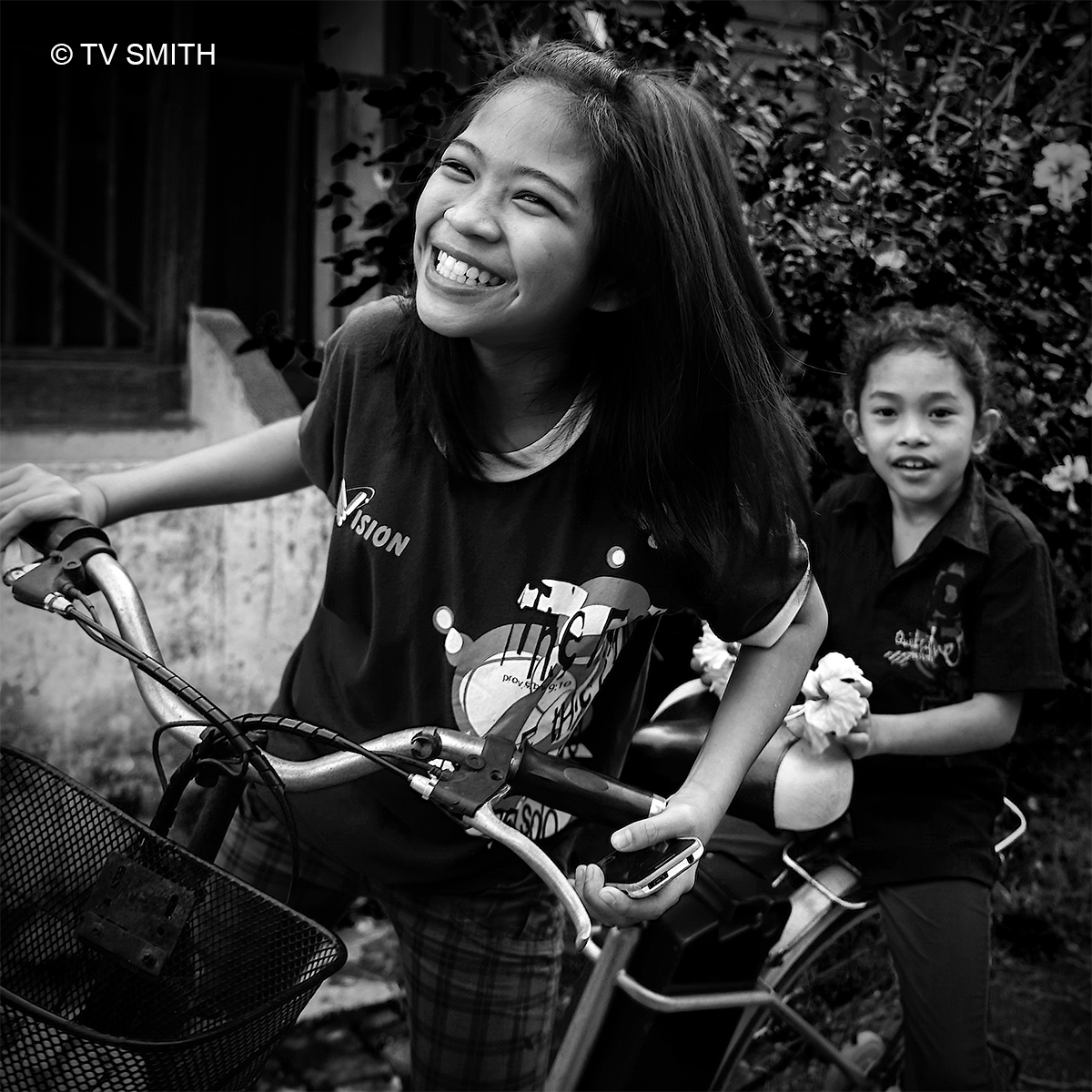
Wawa,11, and her friend Mia, 10, riding alongside my car. Love her very contagious smile. Kampung Bilal is a tiny village off Federal Route 1 in Hulu Bernam.
Sony Alpha a7R, ISO 100, f4, 1/60 sec.
Wawa,11, and her friend Mia, 10, riding alongside my car. Love her very contagious smile. Kampung Bilal is a tiny village off Federal Route 1 in Hulu Bernam.
Sony Alpha a7R, ISO 100, f4, 1/60 sec.
Driving on this section from Kuala Kubu Bharu to Tanjung Malim brought back some scary childhood memories. The many winding sections of Federal Route 1 saw some of the most horrific head-on crashes.
When it was the only major road to the north or south, the narrow and mostly two-lane road was also the only route for heavy vehicles. The slow, overloaded trucks and buses used to frustrate many a driver following from behind. Many impatient and weary motorists will either tailgate or overtake dangerously.
Some drivers overtook on blind corners and ended up colliding with another reckless (or innocent vehicle) coming from around a sharp bend.
There were police ‘double-line’ traps to deter such overtaking and speeding. Malaysian motorists on Federal Route 1 devised their own warning system. It started with flashing of headlights to warn vehicles on the opposite direction of a forward police operation.
The more vehicles you see flashing, the more reliable is the warning. The more intense or rapid the flicker of high beams, the nearer the cops. Some of you may say, unlike Waze, the system doesn’t identify the cause of the traffic jam in front. It could, surprisingly.
I remember traveling as a kid in my uncle’s car. There was a very long traffic jam and we had no idea of the cause and were slow crawling cluelessly.
My uncle rolled down his window when he saw a door-less timber lorry snail-crawling up the slope from the opposite direction.
Uncle: Flipped two hands and shrugged shoulders [meaning: what is going on?]
Truck driver: Knocked his two fists together twice [meaning: head-on collision]
Uncle: Curled index finger into a hook and shrugged shoulders [meaning: anyone died?].
Truck driver: Curled finger into hook followed by three fingers [meaning: 3 people died]
There you have it. A rudimentary but effective crowd-sourced social traffic information network, ahead of its time.
Olympus OM-D, ISO 1600, f7.1, 1/1600 sec.
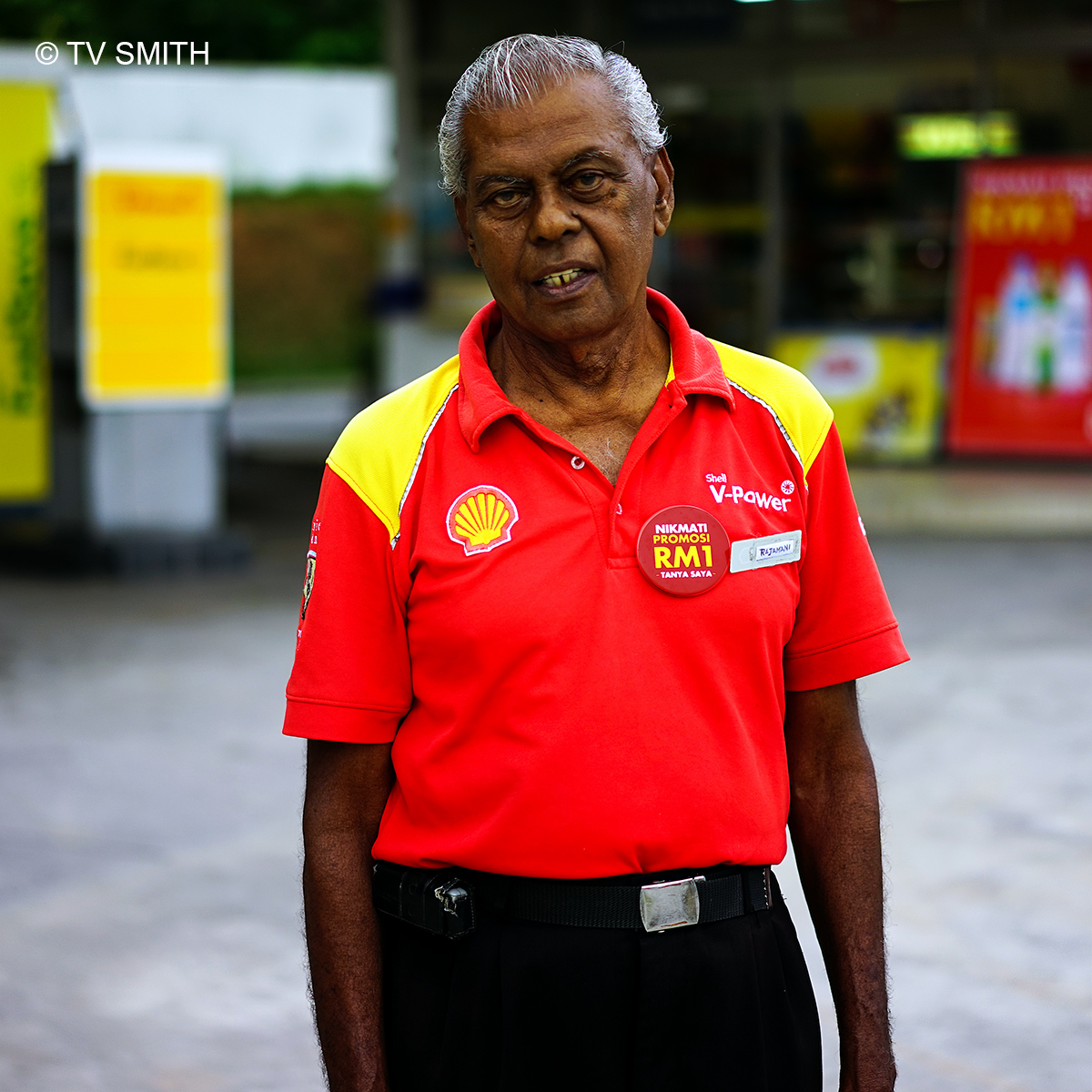
At the turning into Kuala Kubu Bharu town, I stopped to fill up and friendly pump attendant, Mr Rajamani, assisted me. Since he is KKB born and bred, I asked him if that’s anything interesting to see inside. He thought about it for a few seconds and said: “Not, really. Mostly government offices”.
Familiarity breeds indifference or nonchalance, I guess. It turned out to be the town with the most things to see, so far. Glad I went ahead and explored it, running into so many interesting people and places.
A former government servant, Rajamani has worked at this Shell station for the past 20 years after retiring from civil service. He is now 78, fit and sharp.
I am here again to refill before continuing north on Federal Route 1. Jaded as he was, his face light up when I showed him pics of some of the KKB residents I captured. He smiled broadly as he identified each by name.
Before I drove off, I asked him a question that was bugging me:
Me: “Were petrol stations, such as this one, affected when the highway opened up and transit traffic by-passed the small towns?”.
Rajamani: “Not, really”.
Me: “How is it?”.
Rajamani: “Locals have cars too lah”.
Photography Tip: On a road trip, pack along a small low-light lens but not for bokeh or stylo-mylo purposes. I put it to good use here where twilight was fast fading.
I normally click as I converse, composing with the rear LCD screen so that my face is visible to the subject. With the Sony Zeiss Sonnar T, I was able to dial a fast enough shutter speed to hand hold with one hand and also to freeze a very animated subject.
Goodbye KKB, thanks for the friendships and memories.
Sony Alpha a7R, ISO 100, f1.8, 1/250 sec.
In building the dam and subsequent flooding of the jungle area, 2 Orang Asli villages, comprising 84 families, were relocated and re-settled. They moved from their traditional jungle homes into a colony-like housing area with brick houses and relatively modern amenities.
Going up and down a hill behind the dam, I came upon one of the settlements. It has been more than 10 years since, and some of the houses are a bit worn. Saw only kids playing outside but there was an adult.
I asked him if I can take his picture. He nodded affirmatively. Then he nodded to every question I asked, like as if he was lost in his own world. Maybe it was the satisfaction of the long cigarette draws or blissful daydreaming. As an ex smoker, I understand the feeling.
Wall graffiti aside, there is so much to read silently here. The floor mop is a symbol of different abode and lifestyle. There is a bridging symbol, too. Parts of the rusted and broken metal stair railings were replaced with bamboo from the jungles.
Sony Alpha a7R, ISO 100, f5, 1/320 sec.
Downtown, KKB.
You know you are in Kuala Kubu Bharu town when you see tiled roads with low-lying mountain mists in the background. Is easy to think of it as a foothill town to Fraser’s Hill. It is not and it will take another hour or so to reach the foothill at The Gap.
For me, the standout characteristic is the town’s spotlessly clean roads, sidewalks and even back lanes. It takes either a disciplined cleaning regime by the town council or a very civic conscious mindset of the dwellers. I think is both.
Sony Alpha a7R, ISO 100, f4, 1/320 sec.