Nine Emperor Gods Festival Procession In Jinjang – Part 3.

I have seen many strange things in my life but it was still startling to see a Malay or Muslim-looking guy taking part in a Taoist parade. Baffled, I walked alongside him and started a conversation.

Me: Selamat berpesta, bro. (Happy festival, bro)

Guy: Sama sama (likewise).

Me: Boleh tanya, hang in mewakili dewa yang mana satu? (if I may ask dude, which deity do you represent?)

Guy: You bukan Melayu? Saya pun. (You not Malay? Me neither).

Me: Kanasai (like shit in Hokkien).

Guy: Saya Latuk Kong, bro [after which he gave me a fist bump]

Latuk Kong or Natuk Kong is the roadside deity with roots in pseudoreligion and animism.

The deity’s most ardent followers are lottery punters who will kneel before the familiar red wooden shack under a tree to request for a lucky number.

Those fans who strike the at the lotteries will repay the deity’s kindness by building a concrete hut and offer more bananas and other fruits.

Latuk Kongism was recently elevated to major religion status when Pokemon Go designated the shrines as Pokestops in Malaysia.

Latuk Kong: Do you have a light, bro?

Me: No! I am hoping you won’t smoke because your crazy entourage is already choking everyone with excessive kemenyan (benzoin) smoke.

Sony Alpha a7R, ISO 1000, f4, 1/80 sec.
Nine Emperor Gods Festival Procession In Jinjang – Part 4

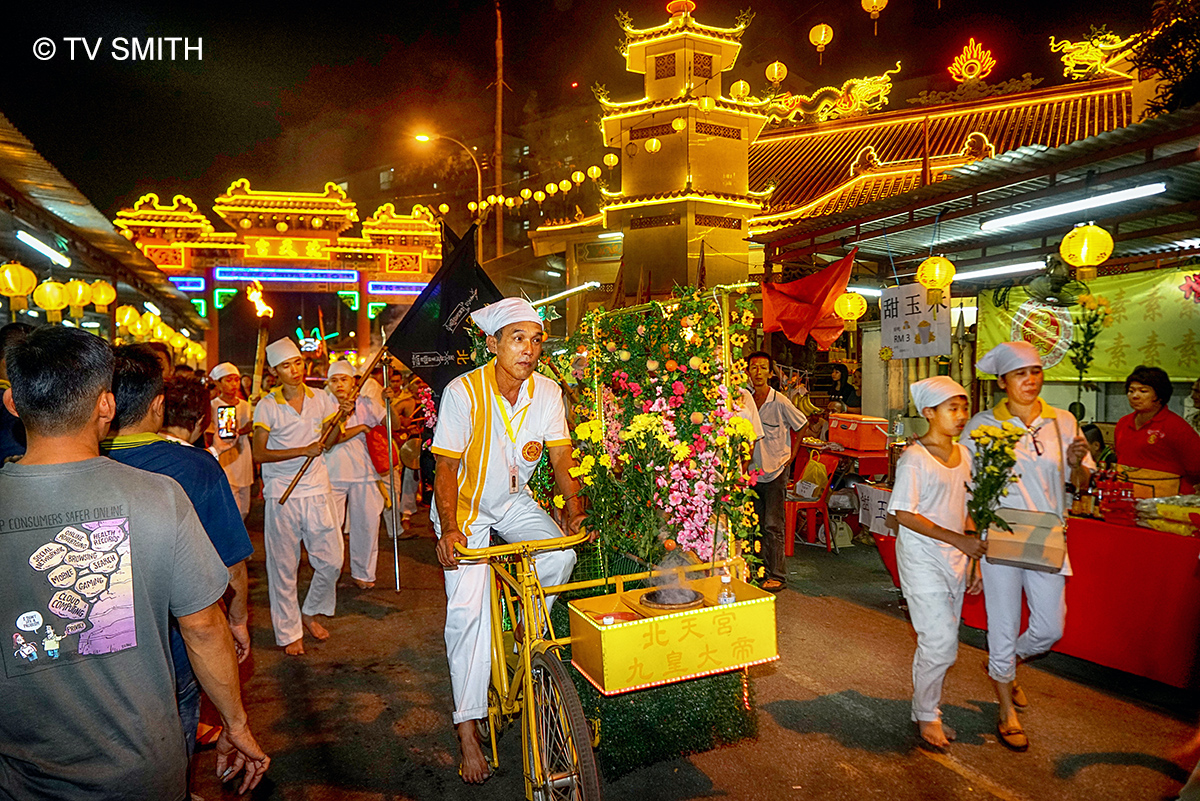
It is currently almost unknown and under-promoted. I asked the cycling man about the significance of pedaling the tricycle. He told me has no idea. Lol.

Besides talking to strangers, I spent most of my time adjusting the flash strength as the white attire worn by devotees can over-expose or burn out easily.

One thing I learned is that the standard zoom (24 to 70mm) lens and tiny HVL-F20M flash were sufficient for the parade. Felt like jettisoning the redundant heavy prime lenses and powerful HVL-F60M flash I brought along but my car was too far away.

Always travel light when you don’t know how far you will be walking.

Sony Alpha a7R, ISO 1250, f4, 1/80 sec.

Nine Emperor Gods Festival Procession In Jinjang – Part 1

The roads here are a maze so I had no idea of the route the parade will cover. Heck. I don’t even know where my car was parked but I did bread crumb my tracks with a pic on my phone camera at every junction or turn during the walk.

Jinjang was a Chinese village notorious for gangsterism and triads many years ago. At one time, no taxis will send passengers in for fear of ambush by the gangs.

The gangs are gone or are silver haired now. The Chinese community solved the gangsterism and associated social problems by sending their kids to college. This broke the vicious cycle but it is to have another impact on the festival which I shall discuss in the next post.

As a photographer, my attitude was to cross the bridge when I get there, prepared to face all eventualities since it is my first time at their parade. There’s smoke, there’s fire and the Pak Thian Kiong temple is beautifully lit tonight. Am loving it but wished they started during the magic hour.

Sony Alpha a7R, ISO 400, f4, 1/80 sec.

Fish Cake From The Hokkien Mee Stall

The fish biscuit, as it is known in Chinese, is usually made from either the Spanish Mackerel (Ikan Tenggiri) or the Wolf Herring (Ikan Parang).

The latter is also known locally as Saitoh Fish (in Chinese) because of its machete (parang) shape.

Unlike English fish cakes made from cod and potato patty, the Asian fishcake is without batter and uses freshly minced fillet paste mixed with flour.

When well done, the fish cake should not be too oily and possess an aromatic flavour. Under the fried crispy skin is the soft but springy fillet that melts in your mouth.

This is one of the better ones from Restoran Xin Yuen Kee in Kuala Kubu Bahru, famous for its Lor Mee.

Sony Alpha a7R, ISO 1000, f9, 1/80 sec.

Nasi Goreng U.S.A.

I always thought the fried rice has some kind of American influence. Indeed it has a fascinating history and is crossover food.

The common explanation and assumption is that the U.S.A. abbreviation stands for Udang (Shrimps), Sotong (Squid) and Ayam (Chicken). There’s also an omelette on top or wrapped around the fried rice.

Its real origin or influence ought to be the American Fried Rice (ข้าวผัดอเมริกัน) dish, invented by the Thais during the Vietnam War.

It has American side ingredients like fried chicken, omelette, hot dogs and ketchup. The Americanization of the spicy Thai fried rice was to cater to American soldiers stationed in Thailand during the war.

Today, it can be found in the menu of Thai restaurants in the States and is listed as “Khao Pad American”.

Not surprisingly, many Tom Yam and Nasi Pattaya stalls serve this dish here. Locally, this is a dish where no two restaurants serve it the same way.

This one is from Restoran Studio 5 in Ampang Jaya. Even the 3 chefs in the 3 shifts here, cook it differently. Show this pic if you want the same version.

Sony Alpha a7R, ISO 1600, f13, 1/80 sec.