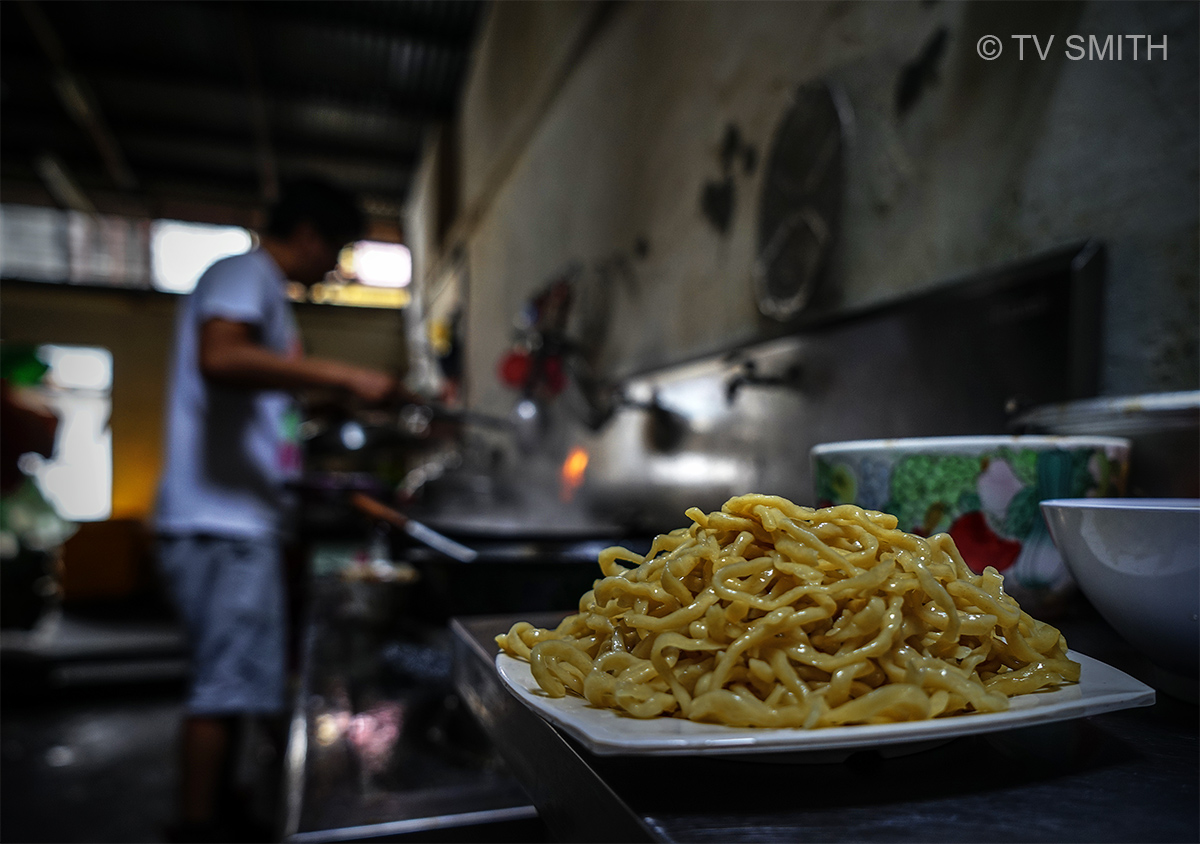
Yellow Noodles On A Red Brick Road

I’m still in Kuala Kubu Bharu town and at a shop famous for Ulu Yam ‘Lor Mee’. It is a Hokkien dish of yellow noodles cooked with a thick gravy of corn starch, spices, meat and eggs. It also tastes sour as vinegar is added for the distinctive flavour. What is special about authentic Ulu Yam Lor Mee?

The yellow noodles are hand made or hand-pulled. According to chef and owner Lim Kwee Hock there is no artificial colouring, flavouring, preservatives nor is brine added. Brine creates the familiar love or hate pungent smell.

Now that you know, you may want to check out Restoran Xin Yuen Kee (non-halal) when you are in Kuala Kubu Bharu town. Lim’s grandfather opened the first restaurant in Ulu Yam Lama. A 2nd generation successor opened another shop in Batang Kali. Their grandson is operating this outlet in KKB.

It is not that common to see a third generation descendent interested in a family business enough to inherit the recipes and to cook. Young Lim and his wife Elaine operates this simple eatery by themselves. The Lor Mee and other dishes taste very good and prices are reasonable.

Photography Tip: Sometimes, the best food shots aren’t just on the table. Ask for permission and go for some unconventional or less seen angles in the kitchen. Traditional Chinese kopitiam kitchens are usually dark, moody and full of character.

Sony Alpha a7R, ISO 320, f4, 1/60 sec.

Downtown, KKB

Downtown, KKB.

You know you are in Kuala Kubu Bharu town when you see tiled roads with low-lying mountain mists in the background. Is easy to think of it as a foothill town to Fraser’s Hill. It is not and it will take another hour or so to reach the foothill at The Gap.

For me, the standout characteristic is the town’s spotlessly clean roads, sidewalks and even back lanes. It takes either a disciplined cleaning regime by the town council or a very civic conscious mindset of the dwellers. I think is both.

Sony Alpha a7R, ISO 100, f4, 1/320 sec.

Ampang Pecah

From Kerling, I turned east on Federal Route 1 to head for Kuala Kubu Bharu town. Although KKB is rich in history and its route to the east is geographically significant, the town is known more for its colonial charm and surrounding greenery.

Hipsters flocked there for different reasons, though. The Hainanese bread shop that used to beguile them is now closed. Not to worry: they now lie on the middle of the road for a selfie. They pretend the modern interlocking tiles are ancient cobblestones.

KKB is also a stopover town for those traveling to Fraser’s Hill. Oddly, few visitors wonder about the logical existence or location of an older town.

Indeed, there was a Kuala Kubu without the fancy suffix or hip abbreviation. Tragedy struck the original town in 1883 when a nearby dam broke. It flooded and destroyed the entire town, killing a few dozen residents.

The then British colonial government built a replacement town a few kilometers away and it was named Kuala Kubu Bharu. Duh.

The annihilated town was subsequently renamed Ampang Pecah to mean Broken Dam in Malay.

This landscape was photographed in the Ampang Pecah area. With over a century to heal, it has recovered from site of mass destruction to become a serene and idyllic suburb of KKB. Few outsiders ever step foot here or know about its stormy past.

Sony Alpha a7R, ISO 100, f11, 1/800 sec.

Kerling Hot Springs

Met a Chinese family swimming in the river and they asked me where I am from. I told them KL and they asked: “How on earth did you manage to find this place?”. They said even though they are locals, they got lost getting here the second time around.

Since it is a weekday, the place is almost deserted. I was told on crowded weekends, it is also visited by locals mostly. Nice that the locals have their own secret and very remote hideout for recreation and picnics. Maybe not (so secret) anymore.

I went to look for the hot springs on another side. It is channeled into a pool and inside was sweet Sheela with the coy smile, and splashing hot water Kollywood-style. She’s also a local and works in an office in Batang Kali.

Sony Alpha a7R, ISO 100, f11, 1/400 sec.

The Rusty Bridge

I was told there is a nice waterfall and hot springs in the jungles of Kerling. There is a sign by the main road but it turned out to be quite a long road in. The drive started parallel to a railway track, twisted through rustic villages and ended up alongside rolling hills.

With such picturesque scenery, is easy to miss a follow-through sign, if there was one in the first place. At certain crossroad, road split or T-junction you are on your own.

You can either make a wild guess or an educated guess. At one sign-less junction, I stopped by the roadside and waited a bit. Sure enough, two helmet-less village girls on a motorcycle came flying out. They were speed-drying their wet hair in the wind. By following the road they rocketed out from, it should take me to a swimming area.

The deeper I went, the narrower and lonelier the road became. I think most people driving alone would have turned back. Somewhere along the way, I saw a rusty bridge over a river. Was quite wobbly to walk on but its appearance against the sunny landscape today made the stopover worthwhile.

Panasonic GM-1, ISO 200, f10, 1/400 sec.