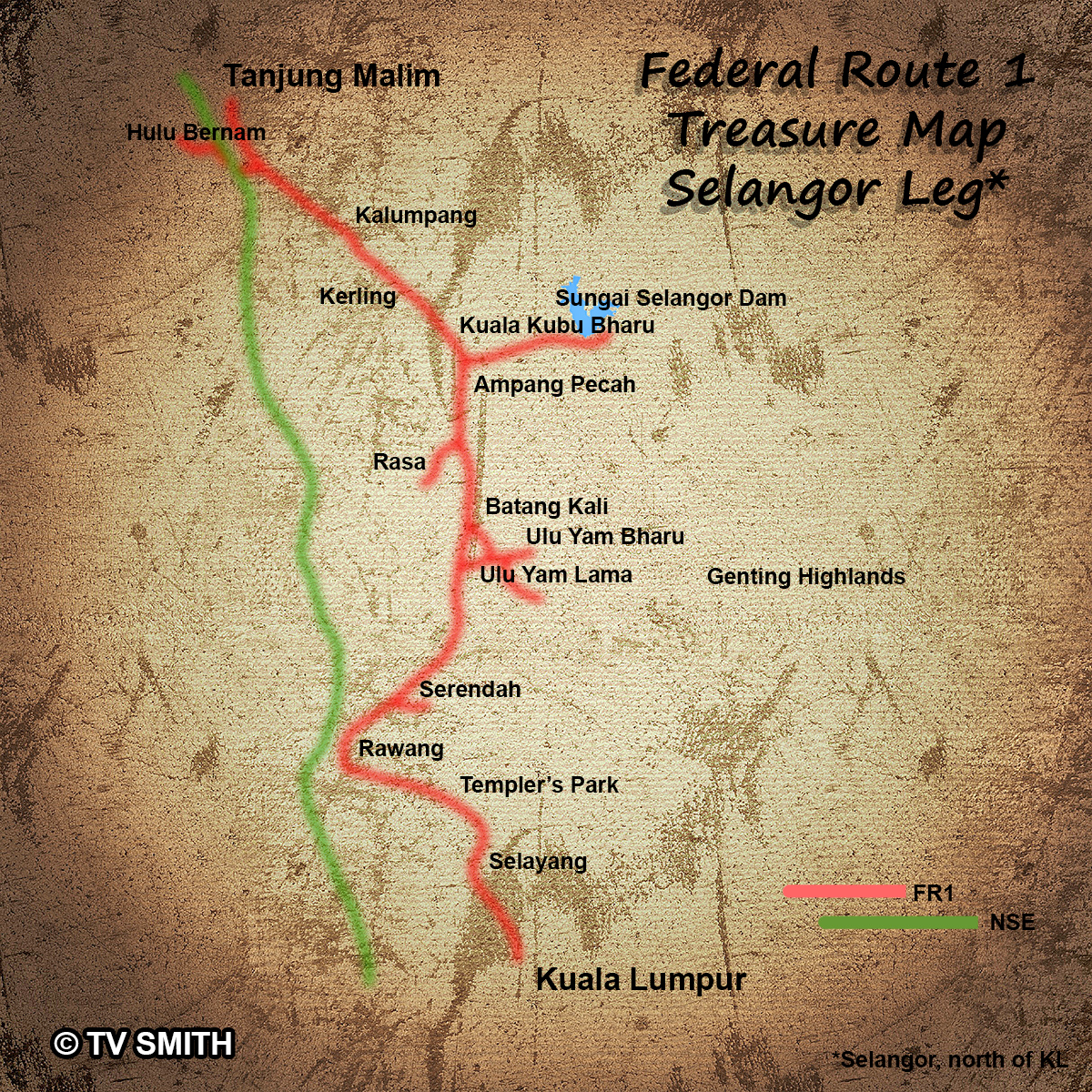
Map – Federal Route 1, North of KL

What was supposed to be a 100 km journey for this stretch took more than 1000 km as recorded by my GPS and odometer. Every town or place on this route is like a treasure chest waiting to be discovered and opened.

The extended mileage was because of the multiple up-down trips back home and to various accommodation locations. There were also numerous detours and excursions to branch roads and such.

Sub-trips sometimes yield little for the camera but were still worthwhile for the additional info I gather from locals about the geography and history.

Here’s a gentle reminder again to not make armchair suggestions. I wrote about the methodology, or lack of, in an earlier post.

As well meaning or well intended and appreciated as they may be, I view them as spoilers. That’s because I work entirely at random. No script, except for what I already know from previous trips.

In fact, as I explained before, I will not even view any other pictures in advance so as to have a clean slate or state of mind with no-preconceived notions.

Every stranger you see featured, I met by chance and it is them, the locals, who drove the direction of the journey by suggesting the next place.

It is not a tourism promo or a paid junket packaged as a travel story for a newspaper or magazine. It is one man’s journey and his honest perspective; simple as that.

This first leg of Selangor (north of KL) has about 70 pictures. The stories were all written on the go, on the fly, on the road and usually, minutes before I post. Please view the series from the start to fully understand how each town connects.

Big thank you to the wonderful people I met so far. Big thanks too to you followers and friends for joining me on this ongoing journey.

You can also follow the series on Instagram, Facebook and Twitter, all under @tvsmithmy

End Of Act 1 – Intermission.

I am now leaving the state of Selangor and entering the state of Perak for which the capital is Ipoh. The city is still a long way ahead in the scheme of things. After a short break, I’ll first explore the border town of Tanjung Malim.

I am sure many of you didn’t know the significance of the digit 1 painted on the old road nor cared. Now that you know, why not hit the road yourself and find the many gems in your own country.

In the next post, I’ll include a route map generated from my GPS tracks and logs. It’ll give you an idea of each location and the relative distance between the towns visited in the Selangor leg of the journey.

Sony Alpha a7R, ISO 100, f5.6, 1/400 sec.

The Way It Used To Be

Like a fading 3R print, this scene in Hulu Bernam is reminiscent of days gone by. Kampung houses on stilts and children kicking around outside.

While one can still find many such settings in rural areas, this one has an invisible modern element in the air. This village at the border of Perak is billed as a Kampung Tanpa Wayar (Wireless Village).

Photography Notes: Things to do when you are bored in a small town hotel and have a laptop with you. One of the most noticeable self-destructing effect of old colour prints is the magenta shift due to dye aging, light damage and latent chemical reaction.

To achieve the old picture look, I altered the magenta and green balance and added the finger print with Photoshop CC. Scratches, staining and dirt were added via Snapseed Desktop.

A subtle pixel shift in focus was also required as the modern-day a7R is very sharp. Looking at some of the prints from my Canon T90 film camera (dubbed The Tank by Japanese photojournalists), they appeared reasonably sharp too in spite of the subsequent colour fade.

Sony Alpha a7R, ISO 640, f4, 1/640 sec.

Only Chinese In Kampung Bota Singh

Saw a signboard that says Kampung Bota Singh in the Hulu Bernam area and decided to drive in. Heh. Didn’t I meet the only Singh in a Chinese village a few days ago? This time at a village named after a Singh, I met a lone Chinese guy holding a pair of garden shears.

Mr Ng who is 69-years-old and a Hakka, held on to the shears menacingly as I introduced myself. He soon let his guard and the shears down and started telling me the history of the village.

The former rubber plantation land was owned by a wealthy Sikh named Bota Singh. In fact, many of the land around here are owned by Sikhs, according to Mr Ng. He and his family bought the land from the now deceased Bota Singh.

I noticed an old-fashioned kitchen cupboard in a messy garage (behind him). You know the type grandma used with four water bowls on its legs to prevent ants from crawling to the cooked food stored inside?

Told him to hang on to it as someday a stranger will come and offer him at least RM 100 for it. The collector will take it back, restore it and some hipsters will gladly pay a thousand ringgit to own one.

He was bemused and flabbergasted. I didn’t know how to explain ‘hipster’ in Hakka or Cantonese. Unadulterated Hakka dialect is quite funny with the standard expletives thrown in. Is quite hard translating it to clean English. Nevertheless, I will try:

Me: Is true, some city people will pay a thousand bucks for it.

Mr Ng: Smelly worn-out birth canal opening, are there really such fools in the city?

Me: There are. We call them “hipsters” in English.

Mr Ng: Hip makai male reproductive organ people! Copulate! Ptui!

Me: Hahaha. You are a jolly man, sir.

Sony Alpha a7R, ISO 250, f4, 1/60 sec.

Standing On Two States

A slim river, named the Bernam River, formed a natural border that separates the states of Selangor and Perak. In the 1700s, a Bugis settlement was established on the riverbank of Sungai Bernam.

Facing the river for this photograph, my left leg was on Tanjung Malim (Perak side) and my right leg on Ulu Bernam (Selangor side).

Sony Alpha a7R, ISO 100, f11, 1/800 sec.