Draw Of The Valley

In building the dam and subsequent flooding of the jungle area, 2 Orang Asli villages, comprising 84 families, were relocated and re-settled. They moved from their traditional jungle homes into a colony-like housing area with brick houses and relatively modern amenities.

Going up and down a hill behind the dam, I came upon one of the settlements. It has been more than 10 years since, and some of the houses are a bit worn. Saw only kids playing outside but there was an adult.

I asked him if I can take his picture. He nodded affirmatively. Then he nodded to every question I asked, like as if he was lost in his own world. Maybe it was the satisfaction of the long cigarette draws or blissful daydreaming. As an ex smoker, I understand the feeling.

Wall graffiti aside, there is so much to read silently here. The floor mop is a symbol of different abode and lifestyle. There is a bridging symbol, too. Parts of the rusted and broken metal stair railings were replaced with bamboo from the jungles.

Sony Alpha a7R, ISO 100, f5, 1/320 sec.

Downtown, KKB

Downtown, KKB.

You know you are in Kuala Kubu Bharu town when you see tiled roads with low-lying mountain mists in the background. Is easy to think of it as a foothill town to Fraser’s Hill. It is not and it will take another hour or so to reach the foothill at The Gap.

For me, the standout characteristic is the town’s spotlessly clean roads, sidewalks and even back lanes. It takes either a disciplined cleaning regime by the town council or a very civic conscious mindset of the dwellers. I think is both.

Sony Alpha a7R, ISO 100, f4, 1/320 sec.

Ampang Pecah

From Kerling, I turned east on Federal Route 1 to head for Kuala Kubu Bharu town. Although KKB is rich in history and its route to the east is geographically significant, the town is known more for its colonial charm and surrounding greenery.

Hipsters flocked there for different reasons, though. The Hainanese bread shop that used to beguile them is now closed. Not to worry: they now lie on the middle of the road for a selfie. They pretend the modern interlocking tiles are ancient cobblestones.

KKB is also a stopover town for those traveling to Fraser’s Hill. Oddly, few visitors wonder about the logical existence or location of an older town.

Indeed, there was a Kuala Kubu without the fancy suffix or hip abbreviation. Tragedy struck the original town in 1883 when a nearby dam broke. It flooded and destroyed the entire town, killing a few dozen residents.

The then British colonial government built a replacement town a few kilometers away and it was named Kuala Kubu Bharu. Duh.

The annihilated town was subsequently renamed Ampang Pecah to mean Broken Dam in Malay.

This landscape was photographed in the Ampang Pecah area. With over a century to heal, it has recovered from site of mass destruction to become a serene and idyllic suburb of KKB. Few outsiders ever step foot here or know about its stormy past.

Sony Alpha a7R, ISO 100, f11, 1/800 sec.

Good Wishes

Wonderful that today is an alignment of Asian festivals. Happy Tamil New Year, Happy Thai New Year or Songkran and Happy Vaisakhi (or Baisakhi), the important holy day for Sikhs.

Saw these statues of a family at a Hindu temple in Rawang, a town on Federal Route 1. Will see if I can also drop by at a Sikh temple that is on-route later.

Sony Alpha a7R, ISO 400, f7.1, 1/400 sec.

Rain Or Shine, The Show Must Go On

One of the things I decided from the get-go was to proceed come rain or shine. It would be impossible to find a continuous stretch of sunny days with the vagaries of our weather.

If it shines, the camera will absorb the colours. If it rains, I get to capture the wet landscape and activities. After all, this is documentary photography and I will go with the flow.

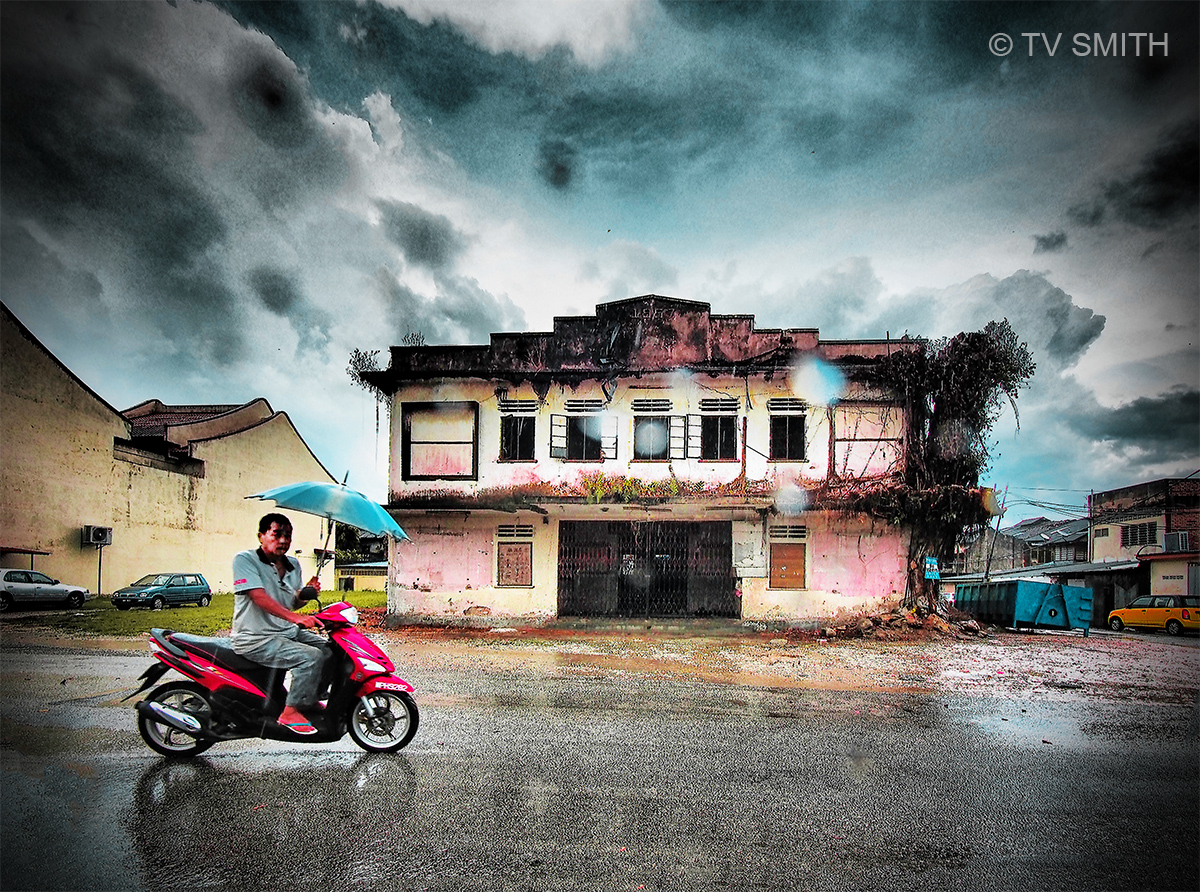
For this cinema in Rasa town, the show didn’t go on. Sad to see a building from 1957 left dilapidated and forsaken. Even sadder to see what looks like an equally old tree by its side; beheaded.

Rasa is the first town on the route that hit me as a dying town. Many of the buildings there are from 80 to 100 years ago but are are left abandoned. I have to find out why.

Olympus OM-D, ISO 200, f7.1, 1/200 sec.