Tepung Pelita

I like this gooey and fragrant dessert served chilled. Contained in a banana leaf boat, the kuih is made from coconut milk and rice flour. The top is creamy and a bit salty while the bottom is sweet pandan-flavoured green.

There is condensation on the surface because I just took it out of the refrigerator.

Sony Alpha a7R, ISO 1600, f11, 1/60 sec.

Fresh From The Oven

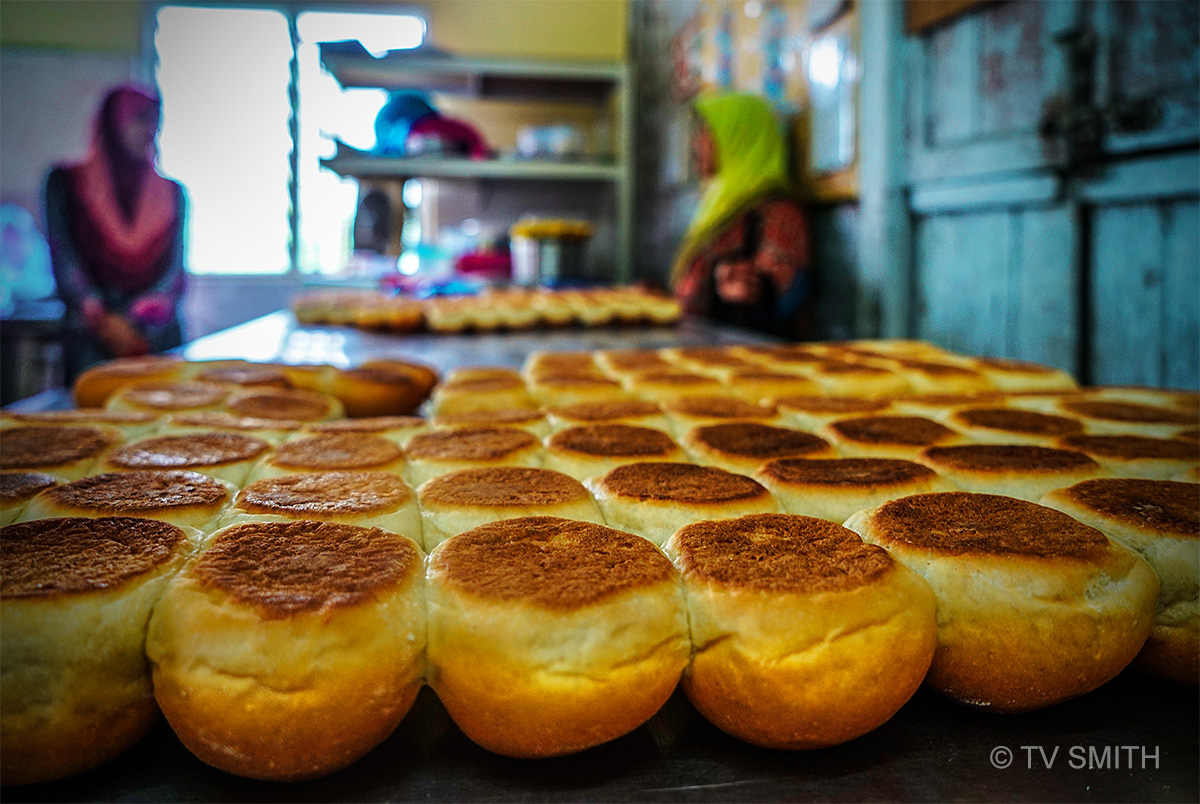
Baker Mokhtar’s late father was Indian-Muslim and his mother a Malay. Like his paternal grandfather, they are from a long line of bakers from Northern India.

I was pleasantly surprised to hear him describe the filling of each type of bread bun in Cantonese. There’s Yeah Chi (coconut shavings), Chee Mah (sesame), Ngau Yow (butter), Kar Yang (kaya or coconut egg jam) and Tau Sar (bean paste); Mokhtar rattled away.

It may seem routine to Mokhtar but if you think about it, what a rich tradition he inherited. Wonderful to taste this heritage product that has adapted to local taste by blending recipes from different cultures.

Mokhtar also bakes regular white Bengali bread loaves but they weren’t ready at the time I was there.

Next: I asked him to show me the big traditional brick oven that he has hidden in another room.

Sony Alpha a7R, ISO 400, f4, 1/60 sec.

The Kopitiam Pasta

I think it was Alisan coffee shop in the Masjid India area that pioneered the food court within a kopitiam. That was in the early 1980s and the concept has since been adopted by many Chinese coffee shops. The big and popular ones may squeeze as many as two or three dozen food stalls into a single shop lot.

Currently, one of the less common types of food served at such places is pasta. With the new burden of GST and the Shringgit (a term attributed to my friend Sidek Kamiso), the poor man’s Italian dining should become more popular.

If you are not a snob, this Seafood Pasta is good value as the portion and ingredients are generous at RM 9 nett. Of course, it won’t taste as good as that from an Italian chef who hand craft his pasta and blend the sauce from some time-tested family recipe.

Nevertheless, I like that I can customise it in whatever way I want at the kopitiam. No snooty chef or maitre d’ protesting because it is heresy to even suggest.

The fat Chinese cook here nodded his head happily when I requested a tomato-based sauce even though it is served dry.

I also like that I can order a barley drink to go with it and have dessert of Nyonya Kuih Lapis bought from another stall outside.

The coffee shop is at one corner of Jalan SJ6, Selayang.

Sony Alpha a7R, ISO 320, f6.3, 1/250 sec.

Bak Chang

Today is Duanwu ( 端午节) or the Dragon Boat Festival or the Chang Festival for Chinese. It falls on the fifth day of the fifth month of the lunar calendar and as such is also known as the Fifth Month Festival in Malaysia, Singapore and Taiwan.

The festival commemorates the life and death of ancient Chinese scholar and poet Qu Yuan. He committed suicide by drowning to protest against the corrupt and dictatorial regime that ruled.

Legend has it that people threw rice into the river both as a food offering to Qu Yuan’s spirit and also to deter fish from eating his body.

Today, symbolic glutinous rice or sticky rice dumplings known as zongzi (粽子) are eaten to mark the occasion. It is a public holiday in China, Hong Kong, Macau and Taiwan. Locally, the bamboo leaf-wrapped dumplings are known as bak chang (Hokkien) or choong (Cantonese).

Interestingly; the Chinese in Indonesia refer to the festival as ‘Peh Cun’ and it is known as ‘Festividade do Barco-Dragão’ in the former Portuguese colony of Macau. The dumplings are known as ‘Machang’ among Chinese Filipinos.

I like this simple dumpling from a roadside seller in Kampung Cempaka. It has salted duck egg yolk, fatty meat, dried shrimps (heh bee), mushroom and importantly for me; no mung beans.

The humble kiosk provides a no-bean option. Freedom of choice: Something which Qu Yuan stood for.

Sony Alpha a7R, ISO 2500, f6.3, 1/250 sec.