The Rohingyas On Land – Survivor From The British Empire

Before I could even respond, he went on to say “The British; they called it diabetes”. I think he was expecting me to ask about his amputated legs and explained that it was due to diabetic complications.

Not surprising to hear an elderly person speak English as Burma and Bangladesh were once under British rule. I don’t wear a watch but I like his G-Shock watch.

Sony Alpha a7R, ISO 320, f4, 1/60 sec.

The Rohingyas On Land – Backstreet Boys

Walked into a back lane to see if there were any Myanmar folk playing takraw (foot volleyball). I saw people playing on some previous Sundays but there were no games this time.

Met the hood and chatted with them. Very jovial bunch of teens and one guy stood out. He looked like a boy band or Bollywood star.

Here’s a dreamy, burned pic in the style of a CD-cover or music video for him.

Sony Alpha a7R, ISO 200, f4, 1/200 sec.

The Rohingyas On Land – Betelmania

A Rohingya hawker wrapping areca nut, herbs, spices, slaked lime and tobacco with betel leaf. The pan-Asian tradition of betel quid chewing goes where the addicts go.

At any local Rohingya or Burmese community, one will see many street kiosks blending their own version of the ancient chewing gum.

In researching the ingredients, I found out there is no such thing as a betel nut. It is actually the areca nut which is not a nut but a fruit. The stone fruit (drupe) causes the infamous and sought-after red staining of the mouth.

Sony Alpha a7R, ISO 800, f4, 1/200 sec.

The Rohingyas On Land – Sugar Baby Love

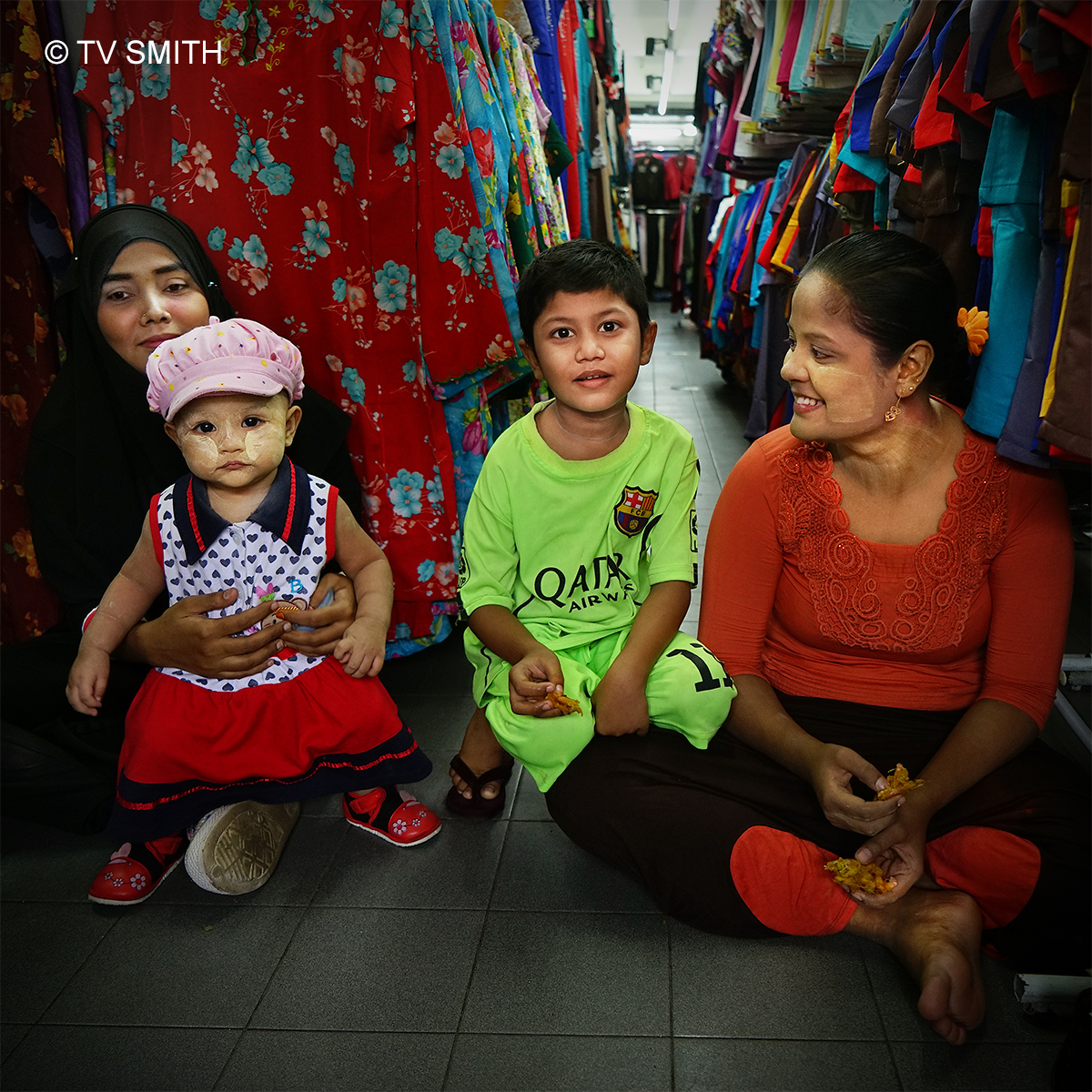
Such sweet and beautiful people, right? The mother (right) works in a garment shop owned by a Chinese. Her employer allows her to bring her child to work and that is good.

Now, for the bitter reality. Not sure about this family but the many kids born here to refugee parents are also stateless. Currently, such children are not accepted into our public schools.

One Rohingya parent told me she is planning to send her kids to southern Thailand. Schools there accept kids with no papers, it seems. Even then, it is limited to primary education, unfortunately.

She reckons it will still be good as her kids can at least read and write some basic stuff. This too, it is not an option for many as they cannot afford to travel as far.

I understand from another lady that UNHCR provides some form of classes. I hope other NGOs will also step in to help such children. The problem is not unique to the Rohingyas, though. It affects all stateless children.

Sony Alpha a7R, ISO 1000, f4, 1/60 sec.

The Rohingyas On Land – Thankful Is The Man Locked Out Of His Own Country

It wasn’t a surprise to hear “Alhamdulillah” or “Praise God” when I spoke to many of the settled Rohingyas today. They do know about the plight of the boat people and feel for them. At the same time, they feel thankful they are in comparatively safe harbour.

On land, all is not as rosy as the smile, as I was to find out. Myanmar’s ethnic groupings are as complex as the nation’s history. Because of persecution, discrimination and inter-communal violence, many Rohingyas won’t admit readily they are one, even here.

When me the stranger asked; many prefer to identify themselves as a Muslim from Myanmar. That is a reasonable reply, considering there are many other Muslim groups in Myanmar, outside the Arakan State.

Picture is of Abdul Rahman, a Rohingya vegetable seller. Wearing the traditional Burmese longyi, he told me I won’t be able to tell ethnicity with certainty, just by looks alone .

According to him, the best way is to make them talk and then discern the dialect. So, that’s how this man was appointed as my personal Rohingya spotter for this part of the neighbourhood.

Sony Alpha a7R, ISO 1250, f4, 1/200 sec.