Bak Chang

Today is Duanwu ( 端午节) or the Dragon Boat Festival or the Chang Festival for Chinese. It falls on the fifth day of the fifth month of the lunar calendar and as such is also known as the Fifth Month Festival in Malaysia, Singapore and Taiwan.

The festival commemorates the life and death of ancient Chinese scholar and poet Qu Yuan. He committed suicide by drowning to protest against the corrupt and dictatorial regime that ruled.

Legend has it that people threw rice into the river both as a food offering to Qu Yuan’s spirit and also to deter fish from eating his body.

Today, symbolic glutinous rice or sticky rice dumplings known as zongzi (粽子) are eaten to mark the occasion. It is a public holiday in China, Hong Kong, Macau and Taiwan. Locally, the bamboo leaf-wrapped dumplings are known as bak chang (Hokkien) or choong (Cantonese).

Interestingly; the Chinese in Indonesia refer to the festival as ‘Peh Cun’ and it is known as ‘Festividade do Barco-Dragão’ in the former Portuguese colony of Macau. The dumplings are known as ‘Machang’ among Chinese Filipinos.

I like this simple dumpling from a roadside seller in Kampung Cempaka. It has salted duck egg yolk, fatty meat, dried shrimps (heh bee), mushroom and importantly for me; no mung beans.

The humble kiosk provides a no-bean option. Freedom of choice: Something which Qu Yuan stood for.

Sony Alpha a7R, ISO 2500, f6.3, 1/250 sec.

Mee Hoon Kueh

Behrang is essentially a Hokkien town. Where Hokkiens ( 福建话 – Fujian people) live, you will find authentic Mee Hoon Kueh in eating places. By chance, I discovered one of the best here. Mee Hoon Kueh is similar to the Hakka hand-pulled “pan mee” or flat flour noodles.

Instead of noodle strips, the flour dough is delicately hand-kneaded with egg and oil into bite-size pieces. It is then brought to a simmer in a broth of ikan bilis (anchovies), pork balls, pork belly slices and sawi (mustard greens). It takes time to cook the dish as you can’t hurry love.

Good thing the boss of Vivian, the Indonesian cook, is always busy with mahjong. She learned the craft, refined it and now makes one of the most awesome mee hoon kueh I ever tasted. She said she might set up a stall back in Surabaya when she retires.

‘Mee Hoon Kueh’ is usually pronounced as ‘Mee Hoon Ker’ outside Penang and the north.

Sony Alpha a7R, ISO 500, f4, 1/80 sec.

Yik Mun’s Hainanese Chicken Chop

Yik Mun kopitiam in Tanjung Malim was a popular stopover during the heydays of Federal Route 1. The Chinese steamed buns shop was an institution.

Now run by third generation descendents, the restaurant is located outside the old town. A shophouse factory in town churns out the assembly-line buns. They are no longer hand-made.

I didn’t order their famous pau (steamed bun) this time. It tasted lousy on a previous visit. Fortunately, the shop sells other local food including the famous Malaysian invention; the Hainanese Chicken Chop.

I am a bit OCD when I see salad dressing carelessly splashed all over the dish. The Hainanese chicken chop’s gravy is a speciality by itself. Typically, it has oyster sauce, HP sauce, Worcestershire sauce and blended secret ingredients in it. It must not be contaminated with Thousand Island dressing.

That aside, the chicken chop here tasted “so so” and the portion seems to have gotten smaller. At RM 14 ++, it is not cheap for a small town.

Nevertheless, the shop was packed when I was there. I guess a good reputation from the past can go a long way. Try it yourself and let me know what you think, if you are in town. Yik Mun is Halal.

Sony Alpha a7R, ISO 1000, f4, 1/60 sec.

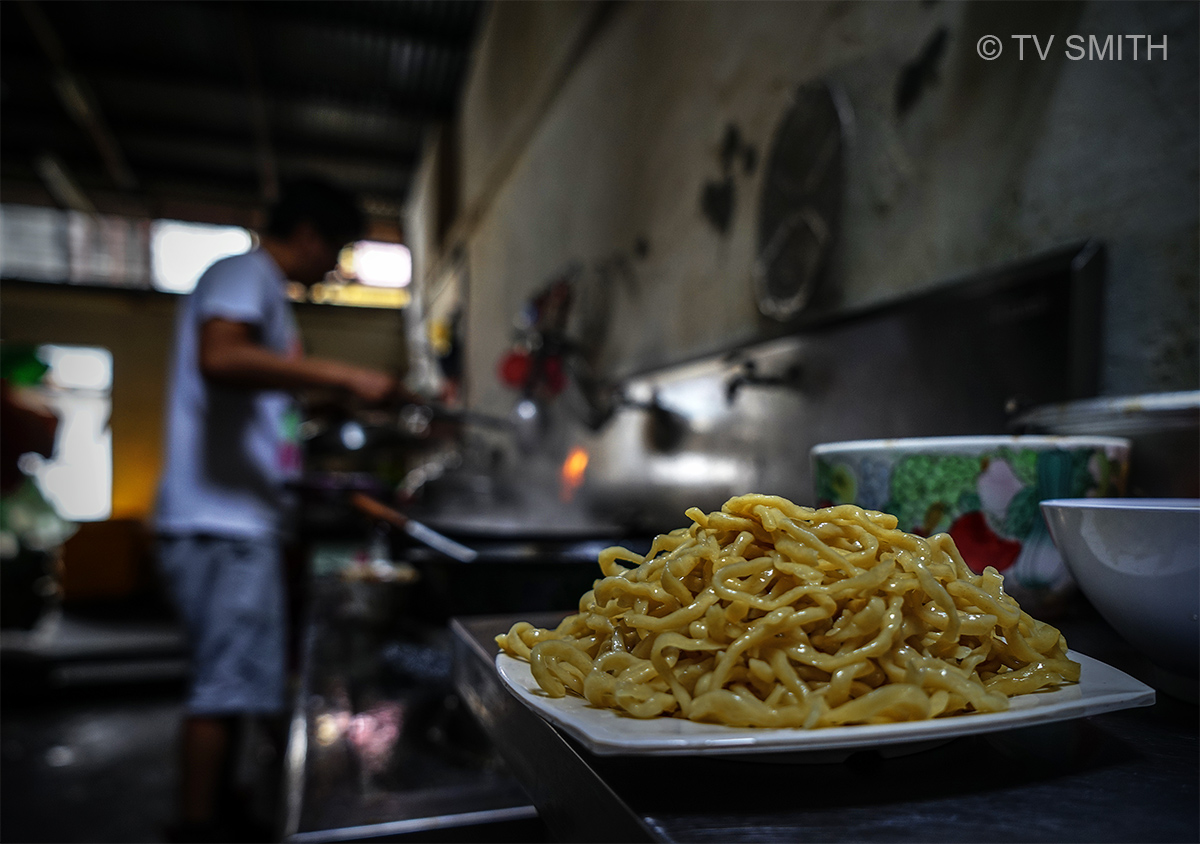
Yellow Noodles On A Red Brick Road

I’m still in Kuala Kubu Bharu town and at a shop famous for Ulu Yam ‘Lor Mee’. It is a Hokkien dish of yellow noodles cooked with a thick gravy of corn starch, spices, meat and eggs. It also tastes sour as vinegar is added for the distinctive flavour. What is special about authentic Ulu Yam Lor Mee?

The yellow noodles are hand made or hand-pulled. According to chef and owner Lim Kwee Hock there is no artificial colouring, flavouring, preservatives nor is brine added. Brine creates the familiar love or hate pungent smell.

Now that you know, you may want to check out Restoran Xin Yuen Kee (non-halal) when you are in Kuala Kubu Bharu town. Lim’s grandfather opened the first restaurant in Ulu Yam Lama. A 2nd generation successor opened another shop in Batang Kali. Their grandson is operating this outlet in KKB.

It is not that common to see a third generation descendent interested in a family business enough to inherit the recipes and to cook. Young Lim and his wife Elaine operates this simple eatery by themselves. The Lor Mee and other dishes taste very good and prices are reasonable.

Photography Tip: Sometimes, the best food shots aren’t just on the table. Ask for permission and go for some unconventional or less seen angles in the kitchen. Traditional Chinese kopitiam kitchens are usually dark, moody and full of character.

Sony Alpha a7R, ISO 320, f4, 1/60 sec.

Ulu Yam In A Nutshell

Chinese folks from elsewhere go to the Ulu Yam area for one main reason. To try the famous Hokkien ‘lor mee’ there. It is a dish of yellow noodles cooked in a sourish vinegar broth. Although the dish originated in Ulu Yam Lama, several other restaurants at Ulu Yam Bharu serve it.

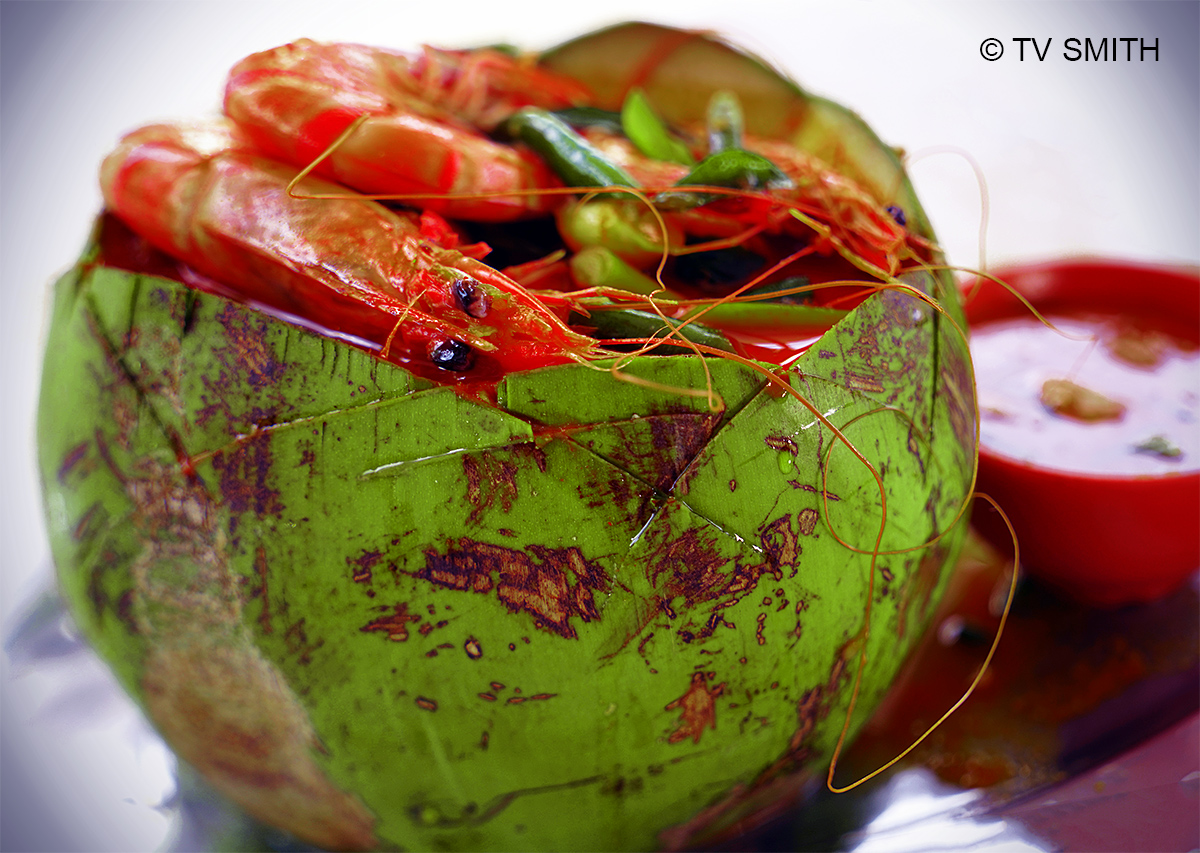
Apart from the now third-generation original shop in Ulu Yam Lama, the other popular ones are Aik Koon and Hock Lay in Ulu Yam Bharu. The former was closed when I was in town looking for food, so I settled for the latter. Fermented acetic acid isn’t exactly my cup of tea; so I asked for another recommendation besides lor mee. The head waitress suggested their signature dish of Shrimps In A Coconut, which she claimed is their creation.

The prawns are cooked in coconut juice (coconut water) and not santan (coconut milk). As a result, the mild curry prawns have a very distinctive fragrance and unique sweet taste. It comes with a tom yum-like dip that is spicy and sour. Excellent fare and reasonable pricing from Hock Lay Restaurant.

Waitress is also talkative, informative and cooperative. She helped me move my food and gear to a darker and cooler corner after I finished photography at a brighter side. Although this dish has no pork in it, the restaurant is not halal. Sony Alpha a7R, ISO 100, f4, 1/250 sec. The nearest decent hotel is The Leverage Business Hotel in Rawang. Available from MyCen Hotels at http://www.mycen.my/