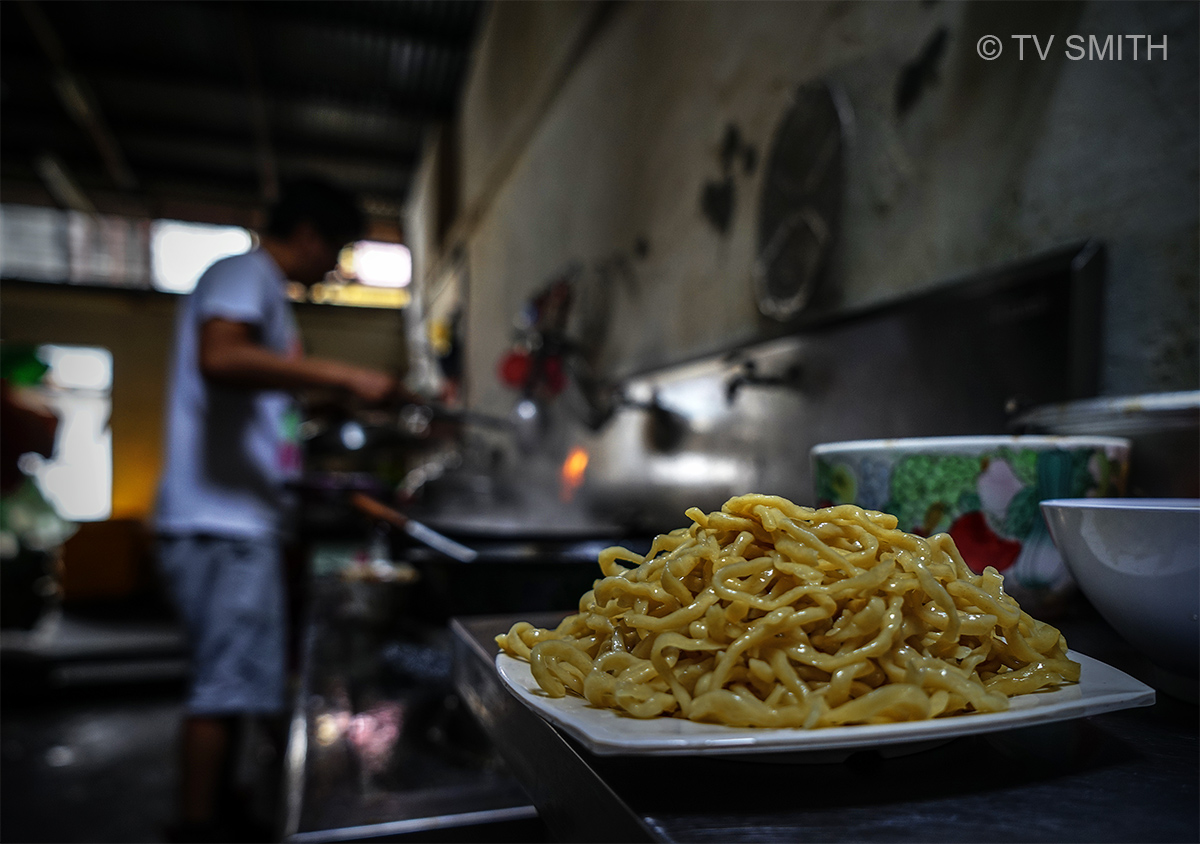
Mee Hoon Kueh

Behrang is essentially a Hokkien town. Where Hokkiens ( 福建话 – Fujian people) live, you will find authentic Mee Hoon Kueh in eating places. By chance, I discovered one of the best here. Mee Hoon Kueh is similar to the Hakka hand-pulled “pan mee” or flat flour noodles.

Instead of noodle strips, the flour dough is delicately hand-kneaded with egg and oil into bite-size pieces. It is then brought to a simmer in a broth of ikan bilis (anchovies), pork balls, pork belly slices and sawi (mustard greens). It takes time to cook the dish as you can’t hurry love.

Good thing the boss of Vivian, the Indonesian cook, is always busy with mahjong. She learned the craft, refined it and now makes one of the most awesome mee hoon kueh I ever tasted. She said she might set up a stall back in Surabaya when she retires.

‘Mee Hoon Kueh’ is usually pronounced as ‘Mee Hoon Ker’ outside Penang and the north.

Sony Alpha a7R, ISO 500, f4, 1/80 sec.

Thinking About Life

At a coffee shop in Behrang, two polite gentlemen asked to share my table. We introduced ourselves, chatted and ended up becoming friends; exchanging phone numbers and all. They even invited me to their village to eat durians.

They are Orang Asli of the Semai tribe (aboriginal people) from nearby Kuala Slim. Sal (left) was busy writing lottery numbers to place bets on. I asked him if I can go to his village to ask for lottery numbers from the tree spirits. The Orang Asli are traditionally animists.

Mon (right) told me to drink up and the numbers will come. Haha. The Cap Rusa (Deer Brand) Chinese ‘Rose Road’ herbal liquor is potent stuff with alcohol content stated as 20%. Not clear if it is measured by proof or volume.

At extreme left, is waitress Vivian originally from Surabaya in Indonesia. It was her cooking that lured me into this shop. I caught whiffs of enticing ‘mee hoon kueh’ boiling when I was on the street outside.

Such wonderful and friendly people, all of them. Listening to their life struggles, stories and beliefs is humbling and enriching at the same time.

Sony Alpha a7R, ISO 2000, f4, 1/60 sec.

The Quintessential Small Town Coffee Shop

A sepia rendition of an old kopitiam in Main Street, Behrang. This is a typical coffee shop found on many one-street towns along the ‘old road’ or Federal Route 1.

Sony Alpha a7R, ISO 100, f6.3, 1/250 sec.

Sleepy Cat In A Sleepy Town

At the entrance of the town (or village) of Behrang Ulu is a striking green-painted shack. It turned out be a fascinating, old school Malay coffee shop.

A banana fritters hawker nearby told me the kedai kopi is opened only in the morning. I think that cat n the chair likes it that way.

Behrang Ulu is quite unique in that it is not only a multi-racial new village but it also has a town sign written in Malay, Chinese and Tamil. Must come again to have coffee and a chat with the locals.

Sony Alpha a7R, ISO 100, f4, 1/250 sec.

Yellow Noodles On A Red Brick Road

I’m still in Kuala Kubu Bharu town and at a shop famous for Ulu Yam ‘Lor Mee’. It is a Hokkien dish of yellow noodles cooked with a thick gravy of corn starch, spices, meat and eggs. It also tastes sour as vinegar is added for the distinctive flavour. What is special about authentic Ulu Yam Lor Mee?

The yellow noodles are hand made or hand-pulled. According to chef and owner Lim Kwee Hock there is no artificial colouring, flavouring, preservatives nor is brine added. Brine creates the familiar love or hate pungent smell.

Now that you know, you may want to check out Restoran Xin Yuen Kee (non-halal) when you are in Kuala Kubu Bharu town. Lim’s grandfather opened the first restaurant in Ulu Yam Lama. A 2nd generation successor opened another shop in Batang Kali. Their grandson is operating this outlet in KKB.

It is not that common to see a third generation descendent interested in a family business enough to inherit the recipes and to cook. Young Lim and his wife Elaine operates this simple eatery by themselves. The Lor Mee and other dishes taste very good and prices are reasonable.

Photography Tip: Sometimes, the best food shots aren’t just on the table. Ask for permission and go for some unconventional or less seen angles in the kitchen. Traditional Chinese kopitiam kitchens are usually dark, moody and full of character.

Sony Alpha a7R, ISO 320, f4, 1/60 sec.