Tepung Pelita

I like this gooey and fragrant dessert served chilled. Contained in a banana leaf boat, the kuih is made from coconut milk and rice flour. The top is creamy and a bit salty while the bottom is sweet pandan-flavoured green.

There is condensation on the surface because I just took it out of the refrigerator.

Sony Alpha a7R, ISO 1600, f11, 1/60 sec.

Laughter In The Rain

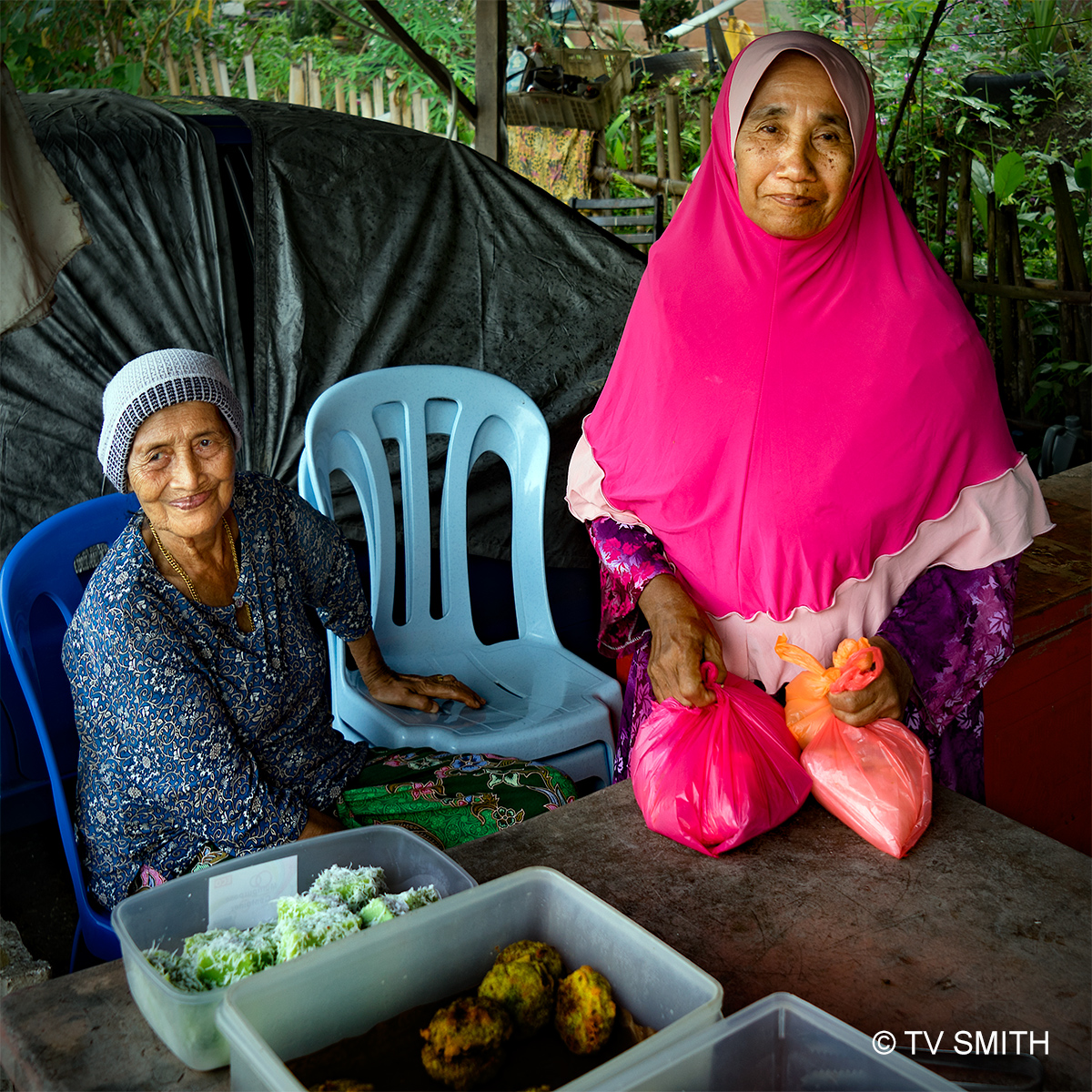
Saw this roadside stall at Ulu Slim on a wet evening. It was operated by a makcik trio. One makcik was too shy and declined to be photographed. Below is our conversation translated into English from Malay (for the benefit of international followers).

Me: Is that your house behind, makcik?

They: Yes. And do you know why we are selling food in front of our humble kampung house?

Me: So that you don’t have to use that shiny new car (wrapped up) to transport the food elsewhere?

They: OMG! Hahaha. No! So we don’t have to pay rent like those selling at the Ramadan bazaar in town. True or not?

Before I can answer they burst out laughing themselves. We started chatting like friends, talking about the cost of trading and life in the kampung. Love their great sense of humour and gregarious personality.

Since they were closing up, I bought almost all the remaining kuih for only RM 5. Yes, their overheads are lower and it is reflected in the price.

Sony Alpha a7R, ISO 125, f4, 1/60 sec.

Mokhtar Le Baker

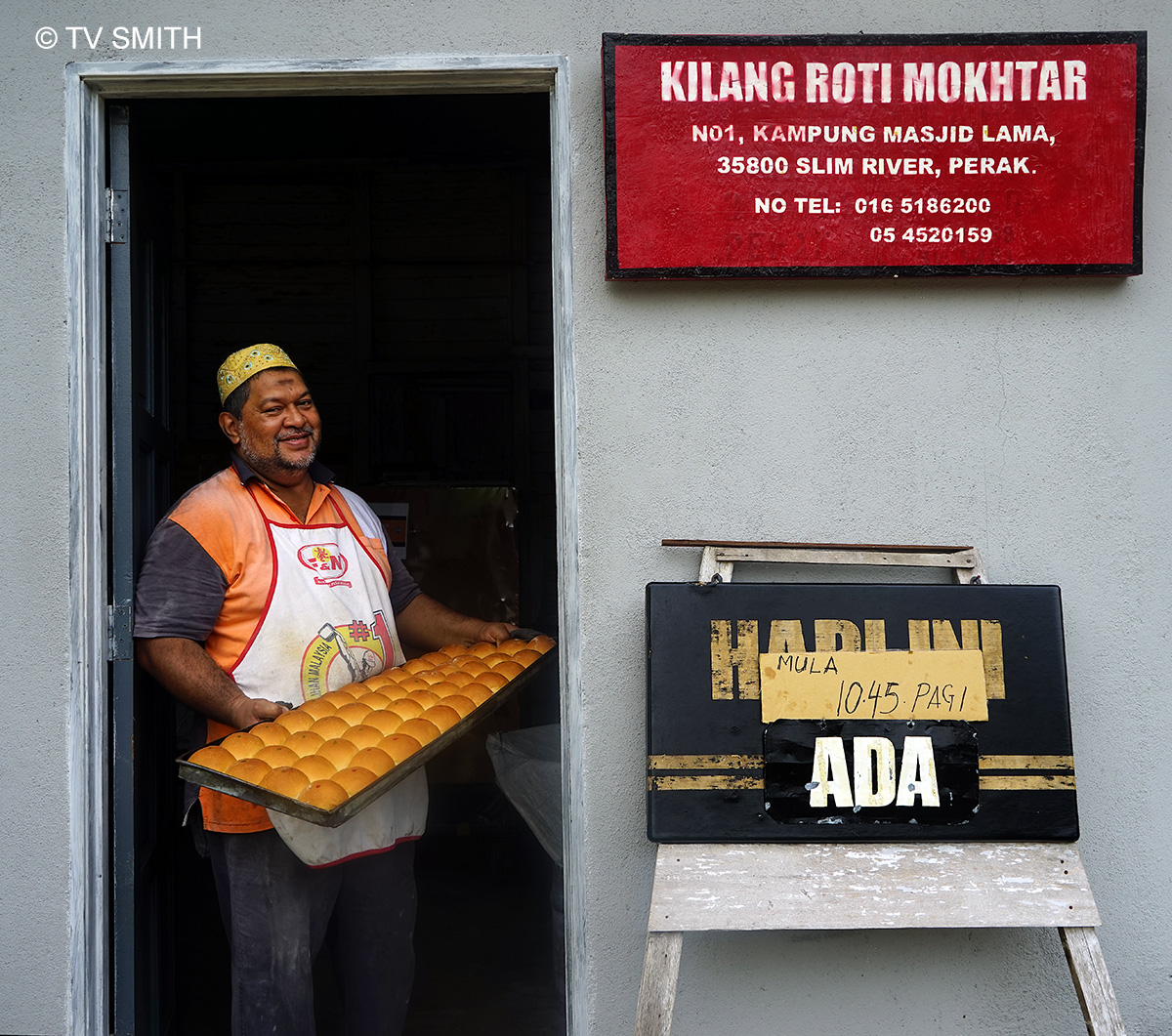
It is unfortunate that this more than half-a-century old bakery is known as a factory (or kilang). In reality, it is a one-man baker outfit and an artisan one at that. Every loaf, bun and pastry is lovingly hand-crafted by Mokhtar himself. No workers, interns or apprentices behind the scenes.

Put him in Klang Valley and call it a boulangerie patisserie instead of kilang and fad-hungry hipsters will swoon all over him , even without him proclaiming sourdough.

We must be thankful that Mokhtar don’t give two hoots about such things. Not even about glutens. The easy-going character don’t care about a lot of things. He opens at 10:30am or thereabouts and closes at 11:30am or thereabouts, earlier when the breads are sold out.

Fortunately for his customers, the man is OCD about signage. On those days when he decides not to open, Mokhtar places signs on the roads outside announcing “Kilang Roti Tutup” (Bread Factory Closed). They are like those middle-of-the-road placards you see when roads are closed for National Day parade rehearsals. After all, the man and the bakery is Slim River’s most famous landmark or attraction.

It took me three trips on three different days before I could catch him in person. Greeted by a shut door previously, I ended up staring at the piles of broken furniture lying around the yard. That kind of gave me a clue on the eccentric character that he is. Don’t tell me he uses all these broken furniture as firewood to fire up the oven, I wondered.

As it turns out, we get along quite well. For I am as eccentric and OCD like him. I keep telling him the door is not perfectly level.

More on the bakery coming up.

Sony Alpha a7R, ISO 100, f8, 1/100 sec.

The Kopitiam Pasta

I think it was Alisan coffee shop in the Masjid India area that pioneered the food court within a kopitiam. That was in the early 1980s and the concept has since been adopted by many Chinese coffee shops. The big and popular ones may squeeze as many as two or three dozen food stalls into a single shop lot.

Currently, one of the less common types of food served at such places is pasta. With the new burden of GST and the Shringgit (a term attributed to my friend Sidek Kamiso), the poor man’s Italian dining should become more popular.

If you are not a snob, this Seafood Pasta is good value as the portion and ingredients are generous at RM 9 nett. Of course, it won’t taste as good as that from an Italian chef who hand craft his pasta and blend the sauce from some time-tested family recipe.

Nevertheless, I like that I can customise it in whatever way I want at the kopitiam. No snooty chef or maitre d’ protesting because it is heresy to even suggest.

The fat Chinese cook here nodded his head happily when I requested a tomato-based sauce even though it is served dry.

I also like that I can order a barley drink to go with it and have dessert of Nyonya Kuih Lapis bought from another stall outside.

The coffee shop is at one corner of Jalan SJ6, Selayang.

Sony Alpha a7R, ISO 320, f6.3, 1/250 sec.

Bak Chang

Today is Duanwu ( 端午节) or the Dragon Boat Festival or the Chang Festival for Chinese. It falls on the fifth day of the fifth month of the lunar calendar and as such is also known as the Fifth Month Festival in Malaysia, Singapore and Taiwan.

The festival commemorates the life and death of ancient Chinese scholar and poet Qu Yuan. He committed suicide by drowning to protest against the corrupt and dictatorial regime that ruled.

Legend has it that people threw rice into the river both as a food offering to Qu Yuan’s spirit and also to deter fish from eating his body.

Today, symbolic glutinous rice or sticky rice dumplings known as zongzi (粽子) are eaten to mark the occasion. It is a public holiday in China, Hong Kong, Macau and Taiwan. Locally, the bamboo leaf-wrapped dumplings are known as bak chang (Hokkien) or choong (Cantonese).

Interestingly; the Chinese in Indonesia refer to the festival as ‘Peh Cun’ and it is known as ‘Festividade do Barco-Dragão’ in the former Portuguese colony of Macau. The dumplings are known as ‘Machang’ among Chinese Filipinos.

I like this simple dumpling from a roadside seller in Kampung Cempaka. It has salted duck egg yolk, fatty meat, dried shrimps (heh bee), mushroom and importantly for me; no mung beans.

The humble kiosk provides a no-bean option. Freedom of choice: Something which Qu Yuan stood for.

Sony Alpha a7R, ISO 2500, f6.3, 1/250 sec.